
Australian search is shifting fast in 2026. Google still dominates, but user behaviour is being reshaped by mobile habits, AI Overviews, zero-click results, and the growing role of LLM-style discovery. The key takeaway for businesses is simple: you can no longer optimise only for rankings. You need to optimise for visibility, answers, and brand demand across Google, Maps, and AI-influenced results.
1. Purpose and Scope
This blog explains how Australians use search engines in 2026, what’s changing, and how to respond with modern SEO, AEO, and strategy that reflects real user behaviour. It covers market share, devices, intent, local and voice search, organic vs paid clicks, and AI-driven changes, with a focus on practical actions Australian businesses can take.
Methodology
We reviewed competitor content structure and topics (statistics, implications, and recommendations), then built an Australia-first dataset using publicly available market share and usage sources. Market share and platform splits are sourced from StatCounter’s Australian datasets, supported by Australian digital context sources and local commentary on AI in search.
Key Definitions
Search engine market share refers to the proportion of search referrals each engine receives. Platform share shows desktop, mobile, and tablet usage. Zero-click means a search ends without a click to an external website. AI Overviews are Google’s AI-generated summaries shown above the results for some queries. AEO targets being the best answer, not just the top link.
2. Core Search Engine Usage Statistics
2.1 Market Share Breakdown (2026)
Current Market Share Distribution
What is the most popular search engine in Australia in 2026?
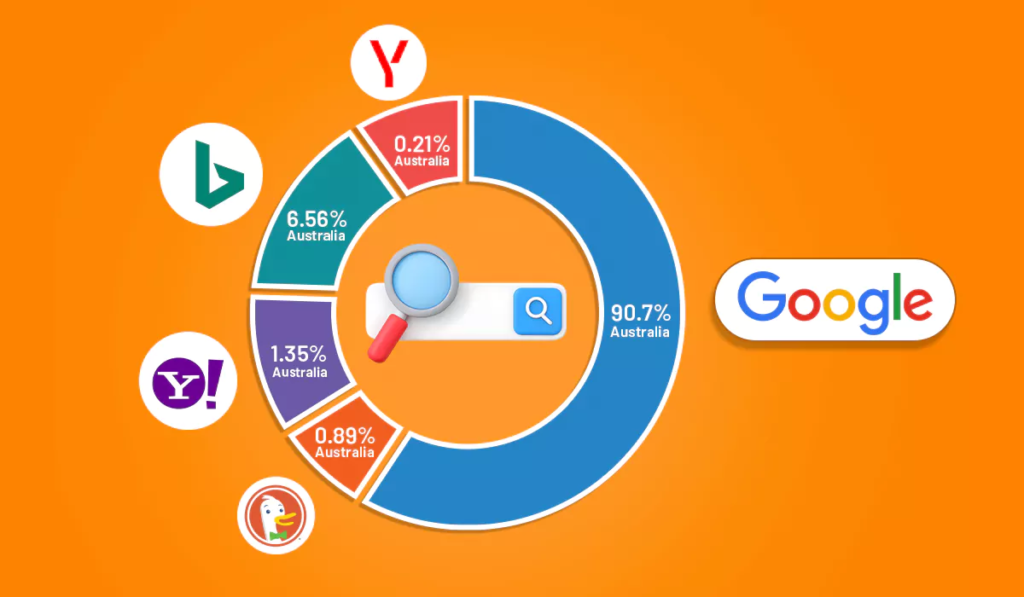
Google remains Australia’s most popular search engine by a wide margin, with around 90.7% market share in January 2026. Bing follows at 6.56%, then Yahoo at 1.35%, and DuckDuckGo at 0.89%. This matters because most “Australia Google search engine optimisation” work still lives or dies in Google’s ecosystem, even when you also plan for alternative discovery channels.
Search Engine Market Share in Australia
How concentrated is search behaviour in Australia?
Australia is unusually concentrated compared to global averages. In January 2026, Google held 90.7% of the Australian search engine market, while its global share stood at 89.82%. That gap is small, but the bigger difference is that Australia’s “long tail” of engines is thinner, meaning fewer meaningful alternatives for scale. For most brands, Google remains the main acquisition lever.
Market share snapshot (January 2026)
| Search engine | Australia market share | Global market share |
| 90.7% | 89.82% | |
| Bing | 6.56% | 4.45% |
| Yahoo | 1.35% | 1.37% |
| DuckDuckGo | 0.89% | 0.74% |
| Yandex | 0.21% | 1.95% |
Year-on-Year Trends (2023-2025)
Has Google’s dominance changed in Australia over recent years?
Year-on-year movement in Australia has been modest compared with other markets. From 2023 to 2025, Google’s lead remains stable, with slight shifts primarily benefiting Bing and privacy-oriented alternatives. The practical implication is that you can forecast search demand and channel mix more confidently in Australia than in markets with bigger swings. You still need to adjust tactics, but not your entire channel strategy every quarter.
Australia vs Global Averages
Google Market Share Comparison
Is Google stronger in Australia than globally?
Yes, slightly. Google’s share is 90.7% in Australia versus 89.82% worldwide (January 2026). That difference is slight, but strategically important: Australian businesses are more exposed to Google algorithm volatility, SERP layout changes, and AI features that reduce clicks. If Google reduces organic visibility through AI summaries or more in-SERP answers, the impact lands harder in Australia because there is less alternative search volume elsewhere.
2.2 Device and Platform Usage
Device Search Share (2026)
Do Australians search more on mobile or desktop in 2026?
Australia is close to a 50-50 split. In January 2026, desktop accounts for 50.43% of platform share, mobile 46.21%, and tablet 3.36%. This is different from the common assumption that mobile dominates everywhere. For marketers, it means optimising for mobile-first experiences without neglecting desktop conversion paths, especially for considered purchases and B2B research.
Browser Market Share Impact
Browser Distribution in Australia
Which browsers shape search behaviour in Australia?
Browsers influence default search settings, privacy features, and how users experience AI features and SERP layouts. In January 2026, Chrome leads at 52.06%, followed by Safari at 31.3%, and Edge at 7.77%. Safari’s significant share matters for iPhone-heavy audiences and local campaigns. Chrome’s lead reinforces Google’s position, as many users stay within Google’s ecosystem.
Demographic Breakdown
Age-Based Preferences
How does age affect search behaviour in Australia?
Working-age Australians are typically the heaviest users of AI tools and multi-format search (text, voice, visual). At the same time, older demographics tend to rely on traditional search patterns and brand navigation. Recent Australian survey summaries suggest around 49% of Australians have used generative AI in the past 12 months, with adoption highest among ages 18–44. This matters because younger users are more likely to accept “answer-first” experiences and click less often.
Regional Variations
Do search patterns vary by region in Australia?
Yes. Proximity needs, service availability, and connectivity shape regional behaviour. Metro areas often exhibit higher paid search competition, stronger “near me” intent, and more map-led discovery. Regional and suburban regions can see higher brand and category queries tied to practical needs (trades, healthcare, education), and a heavier reliance on local results. The best approach is to pair suburb- and service-area-focused content with strong Google Business Profile optimisation.
3. Search Behaviour and User Trends
3.1 Search Frequency and Patterns
Search Intent Distribution
What types of intent dominate Australian searches?
Australian searches commonly split into navigational (brand or destination), informational (learning), and transactional (buy or book). The critical shift in 2026 is that informational intent is increasingly satisfied directly on the results page through AI summaries, featured snippets, and rich results. For businesses, that means you need content that wins the click when it matters, and also content that builds brand recognition even when there is no click.
Most Common Search Categories
Australians commonly search for news and current events, shopping and product research, local services, entertainment, health, travel, finance, and government services. What matters for strategy is matching the page format to intent: service pages for bookings, guides for research, comparison pages for decision-making, and local pages for “near me” demand.
3.2 Local and Voice Search
Local Search Behaviour Patterns
How important is local search in Australia in 2026?
Local search is a major driver of leads for service businesses. A large share of searches has local intent, and map-led discovery is often the first point of contact. Australian local SEO research also highlights the growing impact of “open now” and proximity-based queries. The practical move is to treat your Google Business Profile like your second homepage: services, categories, reviews, photos, and consistent NAP details.
Voice Search Revolution
Is voice search changing SEO in Australia?
Voice search pushes SEO towards natural language and question-based content. People speak differently from how they type. They use longer phrases, ask location-based questions, and want quick answers. Even when voice search volume is hard to measure precisely, its influence is evident in query wording and “near me” behaviour. Optimising for conversational headings, short answers, and local modifiers helps you capture voice-style searches.
Voice Search Use Cases
Common Australian voice use cases include driving directions, nearby services, business hours, quick comparisons, and simple how-to questions. Voice queries also align with urgency. If your pages are slow or unclear, voice-driven users bounce faster. Focus on page speed, clear service coverage, and visible trust signals above the fold.
3.4 Video Search Usage in Australia (2026)
Content Consumption Patterns
How does video influence search in Australia?
Video increasingly supports discovery and decision-making, particularly for product research, tutorials, and reviews. Even when the search starts on Google, users often end up on video results or on platforms Google prominently features. This matters because video can capture top-of-funnel attention while your website captures conversions. The simplest win is embedding short, helpful videos on key pages and using clear titles and schema-friendly structure.
Search Behaviour Evolution
Search is no longer one box and ten links. In 2026, Australians move across text, maps, images, and video, often in the same journey. Your job is to keep your brand visible at multiple touchpoints: local listings, organic pages, video results, and increasingly, answer-style placements.
3.5 Organic vs Paid Search in Australia (2026)
Click Distribution and Performance
Is organic search still worth it in Australia?
Yes, but you must measure it differently. Organic can drive high-quality traffic, but zero-click experiences reduce total clicks for informational queries. Australian commentary on search behaviour notes a growing share of searches that end without a click, while paid placements remain strong for commercial queries. The best approach is to use paid search for immediate demand and SEO for compounding visibility, trust, and lower acquisition costs over time.
Strategic Value
Organic builds authority and reduces dependence on fluctuating ad costs. Paid gives speed and control. Together, they let you own the whole funnel: paid captures bottom-of-funnel buyers; organic nurtures researchers and builds brand recall.
Market Adaptation
In 2026, businesses that win tend to do three things: invest in content that answers real questions, improve conversion paths (forms, calls, booking), and build brand searches through consistent presence across channels.
4. The Impact of AI, LLMs, and Generative Search
4.1 AI Search Adoption in Australia
AI Tool Usage Breakdown
How many Australians use AI tools for search-like behaviour?
Australian survey summaries suggest roughly 49% of Australians have used generative AI in the past 12 months, and around 45.6% have recently used a generative AI tool. This does not replace Google for every query, but it changes expectations. People want direct answers, fewer steps, and clearer summaries. Brands that publish original insights and clear explanations are more likely to be referenced and remembered.
Daily AI Search Habits
Daily use tends to cluster among working-age groups and knowledge-intensive jobs. For marketers, the implication is practical: your future “search visibility” includes being quoted, summarised, or recommended by AI experiences, not only ranking as a blue link.
4.2 Zero-Click and AI Overview Trends
AI Overview Prevalence
How often do AI Overviews appear in search results?
Industry tracking widely cited in 2026 suggests AI Overviews appear on about 21% of Google search results, with a much higher rate for question-style queries. That means your informational content may get visibility without a click, or lose clicks even when you rank well. The response is not to stop publishing, but to write content that earns attribution, brand recall, and follow-up searches for your business name.
Click-Through Rate Impact
Do AI Overviews reduce clicks in practice?
Yes. Multiple studies and industry monitoring show that when AI summaries appear, click-through rates to traditional listings often drop. Australian reporting has linked AI Overviews to reductions in search traffic for publishers, with examples of sites seeing meaningful declines, including one that was reported to be down 35%. For businesses, the lesson is to strengthen conversion-ready pages and invest in brand signals that AI cannot replace.
4.3 AEO, LMO, GEO, and AI SEO
Answer Engine Optimisation (AEO)
AEO is the practice of structuring content so it becomes the best direct answer, both for human and machine summarisation.
Key AEO strategies include:
- Put a clear 1–2 sentence answer near the top of relevant sections
- Use descriptive H2 and H3 headings that match how people search
- Add supporting detail, examples, and steps to prove usefulness
- Use entity-rich language (services, locations, industries, comparisons)
- Keep definitions precise and avoid vague filler
Language Model Optimisation (LMO)
LMO focuses on how LLMs interpret and re-use information. It rewards clarity, consistency, and credibility. If your brand, services, and proof points are scattered, models struggle to accurately represent you.
Generative Engine Optimisation (GEO)
GEO is broader than Google. It’s about being discoverable across generative results, including AI summaries and chatbot-driven recommendations. The winning pattern is original expertise plus strong brand presence across credible sources.
5. Industry and Business Response
5.1 SEO Investment and Strategy
Investment Allocation Shifts
Australian businesses are shifting budgets toward content quality, technical performance, and conversion improvements because rankings alone do not guarantee clicks. The market is treating SEO as a full-funnel channel, not a traffic-only channel.
AI-Driven SEO Tool Adoption
AI tools are now standard for research and workflows, but businesses that rely solely on automation are producing similar, forgettable content. The advantage comes from human insight: Australian examples, real pricing context, local comparisons, and unique experience.
Content Strategy Evolution
The most effective 2026 content strategies:
- Build topic clusters around services and pain points
- Create suburb and service-area pages that are genuinely useful
- Publish comparison and “best option” pages with fundamental criteria
- Refresh key pages when SERP layouts change
5.2 Regulatory and Privacy Developments
Age Verification Implementation
Policy and platform changes continue to affect how audiences access content, especially for sensitive categories. Even small changes in friction can shift traffic patterns between platforms.
Privacy and Data Protection
Privacy expectations continue to rise. Tracking restrictions make it harder to measure individual journeys, which increases the value of brand searches, first-party data, and high-intent conversions.
Business Implications
If attribution gets harder, the brands that win are the ones people remember and search for by name. That means investing in brand visibility and trust signals, not only performance marketing.
6. Future Outlook
Predicted Shifts in Search Engine Usage (2026-2028)
Australia will likely remain Google-led, but discovery will diversify. Users will split journeys between Google Search, Maps, video results, and AI tools. That creates an opportunity for brands that show up in multiple formats, not just one ranking position.
The Evolving Role of AI and LLMs in Search
Google is moving closer to an answer engine experience, and Australian reporting confirms this direction through feature rollouts and traffic impacts. As AI summaries become normal, you should treat content as both customer education and brand positioning.
Strategic Recommendations for Businesses and Marketers
1. Embrace AEO, GEO, and LMO as Core Disciplines
Write to be quotable. Make each section answer-first, then expand with evidence and examples.
2. Build Direct Audience Relationships
Email lists, remarketing audiences, and community channels protect you from sudden SERP changes.
3. Prepare for Paid AI Placements
As AI features expand, paid placements may become more integrated into answer experiences. Plan budgets and creative early.
4. Optimise for Brand Searches
Make your brand easy to remember, easy to spell, and consistent across listings and channels. Brand demand is a defensible moat.
5. Diversify Discovery Channels
Support SEO with social search, video, partnerships, PR, and local listings. Visibility is now multi-surface.
Conclusion
Google still dominates Australia in 2026, with 90.7% market share, but Australians’ use of Google is changing. Desktop remains slightly ahead of mobile, Safari is a major browser player, and AI Overviews are increasing zero-click behaviour. If you want sustainable growth, you need modern SEO that includes AEO, strong local presence, and content that earns both clicks and attribution.
If you want a tailored plan for your industry, Digitalzoop can map search intent, content gaps, and conversion paths based on Australian data and your competitive set.
Frequently Asked Questions
1. How many people use Google in Australia?
Google is used by the vast majority of Australians who access the internet. In 2026, more than 90 percent of online searches in Australia are performed on Google, making it the most popular search engine by a wide margin. This dominance means that most Australians rely on Google daily for navigation, research, shopping, and local services, which is why Google-focused SEO remains essential for Australian businesses.
2. How many Google searches are there per day in Australia?
Australia generates millions of Google searches every day. While Google does not release exact country-level figures, global data combined with population and usage patterns indicates that Australians perform several tens of millions of searches daily. These searches range from quick informational queries to high-intent commercial searches, reinforcing Google’s role as the primary discovery and decision-making platform in Australia.
3. What is the most popular search engine in Australia?
Google is the most popular search engine in Australia by a significant margin. In 2026, Google holds approximately 90.7 percent of the Australian search engine market. Other search engines such as Bing, Yahoo, and DuckDuckGo account for a much smaller share. This level of dominance means that visibility on Google largely determines a brand’s overall search presence in Australia.
4. How is AI changing Google search results in Australia?
AI is changing Google search in Australia by increasing zero-click results and introducing AI Overviews that summarise answers directly on the results page. These changes reduce clicks for some informational searches but raise the importance of answer-focused content, brand authority, and visibility beyond traditional rankings. Australian businesses now need to optimise for Answer Engine Optimisation alongside conventional SEO to stay competitive.
5. Is organic search still valuable in Australia in 2026?
Yes, organic search remains highly valuable in Australia, but its role is evolving. While some searches now end without clicks due to AI summaries, organic results still drive high-quality traffic for commercial, local, and brand-based queries. Businesses that focus on long-tail keywords, strong content relevance, and brand recognition continue to achieve strong ROI from organic search in the Australian market.


