
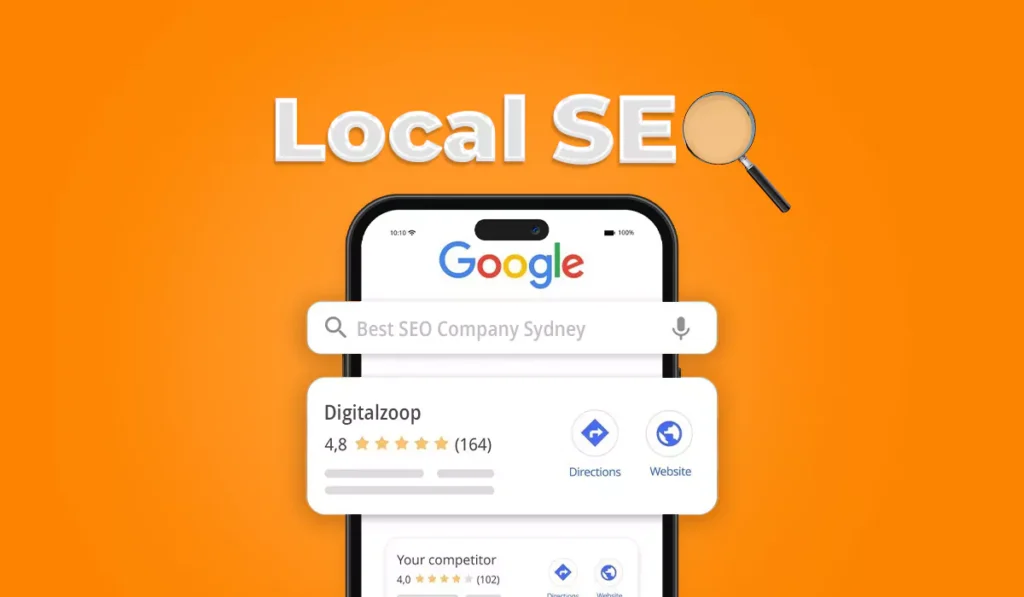
Local SEO is what helps your business show up when Australians search for services “near me”, in a suburb, or in a specific city. It is the difference between being found on Google Maps and being invisible, even if your service is excellent. In 2026, local competition is tighter, customers compare faster, and Google rewards businesses that are both credible and easy to choose.
This local SEO guide gives you a practical framework you can follow, with snippet-ready answers integrated naturally, plus a step-by-step local SEO strategy you can implement without guesswork.
Understanding Local SEO
Understanding Local SEO: Local SEO is the process of improving your visibility in Google’s local results, especially Google Maps and the map pack, so nearby customers can find and contact you. It relies on relevance, distance, and prominence, which your Google Business Profile, reviews, consistent business details across the web, and location-relevant website content shape. Done well, local SEO helps you win calls, direction requests, and enquiries from people actively looking for a provider in your area.
Local SEO is not the same as general organic SEO. Organic SEO focuses on ranking web pages in broader search results. Local SEO focuses on local intent, helping Google quickly show the best nearby options.
Where local SEO shows up in Australia
- The map pack (usually three businesses at the top of local searches)
- Google Maps results
- Local Finder (expanded maps listings)
- “Near me” searches, suburb searches, and “open now” searches
What Google cares about in local results
Google’s local ranking systems revolve around:
- Relevance: How well your listing matches the search (categories, services, content)
- Distance: How close you are to the searcher or their chosen location
- Prominence: How trusted and well-known your business appears online (reviews, links, mentions)
Key Strategies for Local SEO Success
Key Strategies for Local SEO Success: The fastest way to improve local business SEO is to treat your Google Business Profile as your primary local asset, then support it with a trustworthy website and consistent listings across the web. Start by fixing business details, choosing the right categories, adding services, and collecting steady reviews. Next, build location-relevant pages and strengthen internal links. Finally, maintain accuracy and activity to show Google ongoing trust and customer engagement.
Below are the strategies that move the needle most in Australia, especially for service businesses, clinics, trades, and multi-location brands.
1) Google Business Profile Optimisation
This is the core of local SEO for businesses. If your profile is incomplete or mismatched, you can struggle even with a strong website.
Do this first:
- Choose the best primary category (most important local relevance lever)
- Add secondary categories only when they genuinely fit
- Complete services and products (clear, detailed, aligned to what you sell)
- Add service areas if you travel to customers
- Keep hours, holiday hours, and contact info correct
- Upload real photos regularly (team, job sites, before and after, signage)
Google’s local guidance consistently highlights profile completeness, categories, services and NAP consistency as foundational ranking inputs.
2) Reviews as a ranking and conversion lever
Reviews influence prominence and click choice. They also reduce hesitation.
Review basics that work:
- Ask at the right time (when the customer is happiest)
- Make it easy (direct link, short instructions)
- Respond to reviews (including negative ones calmly and practically.
- Avoid sudden spikes that look unnatural.
3) Local listing SEO and NAP consistency
Your name, address, and phone number should match everywhere. Inconsistent formatting or old phone numbers can weaken trust.
What to check:
- Major Australian directories relevant to your industry
- Social profiles
- Local chambers, associations, licensing directories
- Data aggregators, if used
Consistency supports prominence and reduces confusion across platforms.
4) Local pages that are actually useful
A common mistake is creating thin suburb pages that repeat the exact text and swap out location names. That can backfire because it looks like doorway content.
Instead, make location pages genuinely helpful:
- What services are offered in that area
- What’s included and how bookings work
- Service boundaries, travel fees, and emergency availability
- Real proof (reviews, case studies, photos from local jobs)
- Local FAQs customers genuinely ask
Google’s quality and spam guidance strongly discourages thin, near-duplicate pages and rewards people-first usefulness.
5) Website fundamentals that support local rankings
Even though Maps is a listing product, your site still matters.
Prioritise:
- Mobile usability (local searches are often mobile-first)
- Fast load times and stable layout (Core Web Vitals basics)
- Clear calls to action (call, quote, booking)
- Strong internal linking so key pages are not orphaned
Step-by-Step Local SEO Strategy
Step-by-Step Local SEO Strategy: A strong local SEO strategy follows a simple order: fix your foundations, improve relevance signals, build trust signals, then expand coverage. Start with Google Business Profile optimisation and NAP consistency, then publish local service pages and strengthen internal links. Next, build prominence through reviews, local mentions, and quality links. Finally, refine based on performance data, expanding into new suburbs or services only after core areas convert well.
Here’s a clear, repeatable plan you can follow.
Step 1: Audit your current local presence
Create a baseline to measure improvements.
Check:
- Are you verified on Google Business Profile?
- Is your primary category correct?
- Are hours accurate?
- Are services listed clearly?
- Does your website match your listing details?
- Are there duplicate listings?
Step 2: Fix NAP and build listing consistency
Make your business details identical across:
- Website header and footer
- Contact page
- Google Business Profile
- Directories and social profiles
Consistency supports trust and helps Google connect the right signals.
Step 3: Upgrade your Google Business Profile
This is where many local campaigns win or lose.
Focus on:
- Primary category accuracy
- Service list completeness
- Description that reflects real services and areas served
- Photos that show proof, not stock images
- Questions and answers (seed common questions and answer them)
Step 4: Build a local-friendly site structure
For most local businesses, a clean structure looks like this:
- Core service pages (your money pages)
- Location pages (when you have a unique value per area)
- Supporting guides (local SEO guide content that answers common questions)
Example structure:
- /services/
- /services/emergency-plumbing/
- /locations/sydney-inner-west/
- /blog/how-to-stop-a-leaking-tap/
This supports internal linking and passage ranking because Google can understand topical relationships.
Step 5: Create local landing pages that convert
Each location page should include:
- A sharp promise (what you do, who it is for, where you serve)
- Proof (reviews, local jobs, photos, credentials)
- A clear next step (call, quote form, booking)
- A short local FAQ section (only if visible and applicable)
Step 6: Build reviews and prominence steadily
A practical target is consistency, not perfection.
Simple approach:
- Ask every happy customer
- Follow up once
- Respond to every review
- Track review velocity monthly
Step 7: Earn local authority signals
Authority can be built without dodgy link tactics.
Good local authority sources:
- Local sponsorships and community events
- Industry associations and memberships
- Local newspapers and digital PR mentions
- Supplier and partner pages
- High-quality local directories relevant to your niche
Quality and relevance matter more than quantity.
Step 8: Track and refine
Measure what matters:
- Calls and form fills from GBP
- Direction requests
- Website conversions
- Which suburbs or areas generate leads
- Search terms that trigger your listing
Then refine:
- Add new services only when you can support them with content and proof
- Improve pages that get impressions but have low actions
- Expand suburbs carefully, avoiding thin duplicates
Advanced Local SEO Tips
Advanced Local SEO Tips: Once the basics are locked in, advanced local SEO focuses on improving prominence and conversion rate. That means building stronger local authority signals, improving on-page engagement, tightening category and service relevance, and using structured data properly. It also includes managing duplicates, monitoring competitor categories and reviews, and publishing locally applicable content that earns mentions and links. These tactics help you win in tougher suburbs where most businesses have already “done the basics”.
Here are advanced tactics that work well for competitive Australian markets.
1) Align services across GBP and your site
Mismatch is common. If your GBP lists services your site barely mentions, relevance weakens.
Do a simple alignment check:
- GBP services match service pages
- Service pages clearly describe outcomes, pricing cues, and coverage areas
- Internal links point to core service pages from related pages
2) Build topical clusters to support local organic rankings
Local listing SEO improves with better on-site relevance. Topic clusters help you rank for more local searches and related questions.
Example for a dentist:
- Core service: emergency dental
- Supporting articles: toothache causes, when to visit, cost expectations, aftercare
- Local layer: “emergency dentist in [area]” page with real proof
3) Use a schema that truly matches the page
If you use the LocalBusiness schema, ensure it aligns with the visible content. Avoid “markup spam”.
Useful schema types:
- LocalBusiness (NAP, opening hours)
- BreadcrumbList (site hierarchy)
- FAQPage only when Q and A are visible on-page
4) Improve conversion signals on mobile
Local searches often happen when people are ready to act.
Mobile conversion upgrades:
- Sticky call button
- Click-to-call tracking
- Short quote forms
- Service area clarity above the fold
- Fast loading and stable layout (avoid layout jumps)
5) Handle duplicates and location page scaling carefully
If you expand into many suburbs, consolidate where possible. Google’s systems can demote scaled low-value pages that look like doorway content.
Better approach:
- One strong hub page per central region
- Sub-pages only where you have unique proof and unique value
- Merge thin pages into stronger pages over time
6) Competitor monitoring that leads to tangible improvements
Do not copy competitors. Use them to spot gaps.
Check:
- Their GBP categories
- Their review volume and review themes
- Their photos and offers
- Their service area coverage
- Their content topics and FAQs
Then respond with greater clarity, more substantial evidence, and a better customer experience.
A simple weekly routine for local SEO success
If you want local SEO to keep working, maintenance matters.
Weekly:
- Add 2 to 5 new photos to GBP
- Respond to new reviews
- Check GBP insights for search terms and actions
Monthly:
- Audit key directory listings for accuracy
- Refresh one core service page
- Publish one locally helpful article
- Review calls and enquiry quality from local searches
Quarterly:
- Check competitors’ categories and review trends
- Update the location page proof and FAQs
- Improve internal linking across service and location pages
Conclusion
Local SEO success in Australia comes from doing the basics better than most businesses, then staying consistent. Start with Google Business Profile optimisation, fix your business details across the web, and build genuinely helpful local pages that help customers choose you confidently. Then strengthen prominence with reviews and local authority signals, while improving mobile conversions. If you treat local SEO as an ongoing system, not a one-off task, you can build a steady pipeline of calls and enquiries.
If you want help applying this local SEO strategy to your industry and suburbs, Digitalzoop can map the quickest wins and build a plan that’s measurable from week one.
FAQs
1) What is local business SEO?
Local business SEO is the process of improving a business’s visibility in local Google results, including Google Maps and the map pack, so that nearby customers can find and contact them. It focuses on Google Business Profile optimisation, accurate business details across directories, reviews, and localised website content. The goal is to increase calls, enquiries, and visits from people searching for services in your suburb, city, or service area.
2) How long does a local SEO strategy take to work?
A local SEO strategy can start showing movement within weeks if your Google Business Profile and listings have obvious issues, but stronger results usually take 2 to 4 months to build. Timeframes depend on competition, review velocity, and how complete your business information is. Website improvements, local content, and authority signals tend to compound over time, so consistent effort typically beats short bursts of activity.
3) What is local listing SEO, and why does it matter?
Local listing SEO is the work of improving your visibility through business listings such as Google Business Profile and trusted directories. It matters because Google uses consistent business information, categories, reviews, and prominence signals to decide which businesses to show in local results. If your phone number is inconsistent or your category is wrong, you can lose visibility even if your website is strong. Consistency improves trust and rankings.
4) What is the best Local SEO Strategy for businesses with multiple locations?
For multi-location businesses, the best Local SEO Strategy is to create a verified Google Business Profile for each location, keep NAP details consistent, and build unique location pages that include real proof such as reviews, photos, and service specifics. Avoid thin copy-paste suburb pages. Support each location with localised content and internal links to core services. This approach strengthens relevance, prominence, and conversions across suburbs.
5) Does Google Business Profile Optimisation really impact rankings?
Yes, Google Business Profile Optimisation has a direct impact on local rankings because it influences relevance and prominence signals used in Maps and the map pack. Correct categories, complete services, accurate hours, good photos, and steady reviews help Google match your business to searches and improve click choice. A strong profile also reduces friction for customers, which lifts calls and enquiries even when competition is high.


