
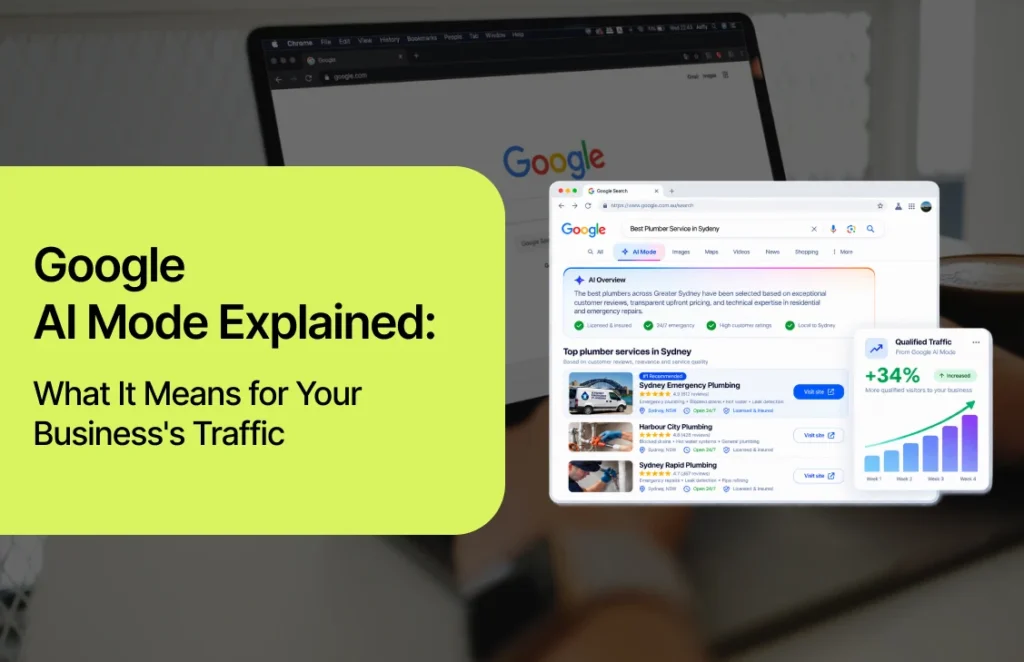
If your organic traffic has dipped over the past year and your rankings have barely moved, you are not imagining things. Google has changed what a search results page is. Google AI Mode, the conversational search experience that launched in Australia on 8 October 2025, now sits alongside AI Overviews as part of a fundamental shift in how Sydney customers find businesses.
This guide explains what Google AI Mode actually is, how it differs from an AI Overview, what it genuinely means for your website traffic, and, most usefully, how to check whether AI in Google search is the real cause of your traffic changes before you spend a dollar fixing the wrong problem.
What Is Google AI Mode?
Google AI Mode is a conversational search experience built into Google Search as a dedicated tab. Instead of returning a page of blue links, it generates a complete written answer to your question, drawing on live web results, and lets you ask follow-up questions that build on the conversation. It runs on Google's Gemini models and can handle long, multi-part questions, images, and voice input.
Think of it as Google behaving like a research assistant rather than a filing cabinet. You can ask Google AI a question the way you would ask a knowledgeable friend, something like "who are the best-rated emergency plumbers near Parramatta that do after-hours callouts", and receive a direct answer that names specific businesses, often without showing a traditional results list at all.
AI Mode rolled out to Australian users in October 2025 after earlier launches in the United States and United Kingdom. It is currently optional, but Google's pattern in other markets suggests it will take a progressively larger share of searches over time.
How Is AI Mode Different From an AI Overview?
People often use the terms interchangeably, but they are different features with different implications for your traffic.
| Traditional results | AI Overviews | AI Mode | |
| What you see | Ten blue links plus ads | An AI summary above the normal links | A full conversational answer in its own tab |
| Where it appears | Every search | A share of searches, mostly questions | Only when the user chooses the AI Mode tab |
| Links shown | Full results list | Summary citations, links below | A small number of cited sources |
| Follow-up questions | New search each time | New search each time | Remembers the conversation |
| Traffic impact | Clicks flow to rankings | Fewer clicks, answer often suffices | Very few citations, so it is cited or nothing |
The practical difference matters. A Google AI Overview still sits above a normal results page, so ranking well retains some value even when an Overview appears. AI Mode replaces the results page entirely. It typically cites only a handful of sources, so visibility becomes binary: your business is either named in the answer or it is invisible for that query.
How Does Google AI Mode Actually Work?
Understanding the mechanics explains why some businesses appear constantly and others never do.
When someone asks AI Mode a question, Google runs what it calls a query fan-out. The system breaks the question into multiple related sub-searches and runs them simultaneously. A single question such as "best physio for desk workers in Western Sydney" might quietly trigger searches around desk-related injuries, clinics by suburb, review patterns, rebate options, and treatment types. The answer is then assembled from the pages that best cover that whole cluster of sub-questions.
Three consequences follow from this design:
- Breadth beats a single page. A business whose site answers the main question plus the surrounding questions gets retrieved across more of the fan-out, so it is far more likely to be cited.
- Freshness is weighted. AI Mode draws on live retrieval rather than a fixed training set, and recently updated pages are favoured. Content that has not been touched in years slides out of contention even when it is still accurate.
- Local data feeds in directly. For local questions, the Google AI search engine pulls from Google Business Profile, Maps, and review data as readily as from your website. Your profile is now answer material, not just Map Pack material.
What Does AI Mode Mean for Your Website Traffic?
Here is the honest picture, without the panic.
Industry studies have reported organic click-through rates falling by roughly a third on queries where an AI Overview appears, and analysis of large Australian publishers has shown year-on-year organic declines of up to around 35 per cent since AI summaries began appearing. Google's own position is that total clicks from Search have stayed relatively stable while the quality of clicks has improved, with visitors spending more time on the sites they do reach.
Both things can be true, because the impact is not evenly spread. In our audit work across Sydney businesses, the pattern is consistent:
- Informational traffic takes the hit. Blog posts answering simple questions, definitions, and how-to basics lose clicks first, because the AI answer satisfies the searcher on the results page.
- Commercial and local intent holds up far better. Someone choosing a conveyancer, booking a pest treatment, or comparing quotes still clicks through, because they need to contact a business to finish the job. When AI Mode answers these queries, it names and links specific businesses, which makes citation the new page one.
- The clicks that survive convert better. Visitors who arrive after reading an AI answer have already done their filtering. Lower volume, higher intent.
So the real risk is not that traffic falls. It is that your business fails to become one of the few names the answer mentions, while a competitor does.
How Do You Know If AI Search Is Behind Your Traffic Drop?
Before rebuilding your strategy, confirm the diagnosis. Plenty of Sydney traffic declines we investigate turn out to be technical problems, lost rankings, or seasonal patterns wearing an AI disguise. Here is a check you can run yourself in under an hour using Google Search Console.
- Compare impressions against clicks. Open the Performance report and compare the past six months with the prior six months. The AI search signature is impressions holding steady or rising while clicks fall. If impressions fell too, your visibility itself has dropped, which points to rankings or technical issues instead.
- Split branded from non-branded queries. Filter for searches containing your business name. If branded clicks are stable but non-branded informational clicks have fallen, AI answers are the likely cause. If branded traffic fell as well, look elsewhere.
- Sort by page type. Check whether the decline concentrates in blog and guide pages while service and contact pages hold steady. That intent split is the classic AI Overview pattern.
- Spot-check the actual results. Search your top declining queries and note whether an AI Overview appears above the results and whether your site is among its sources. What you see is what your customers see.
- Rule out the boring causes. Confirm nothing was noindexed, redirected, or broken in the same period. A migration issue or a lost page can mimic any of the patterns above.
If the evidence points to AI search, the next section is your plan. If it does not, fix the actual problem first. A technical SEO review that covers crawlability, indexing, and local signals will usually surface the real culprit quickly.
Which Sydney Businesses Are Most Exposed?
Exposure depends on how much of your pipeline runs through informational search versus direct local intent.
Publishers, bloggers, and businesses that rely on top-of-funnel article traffic feel the change most sharply, because their entire model depends on the click the AI answer now absorbs. Professional services such as legal, accounting, and financial planning sit in the middle: research queries are being answered on the page, but the eventual "who should I engage" moment now happens inside AI answers that name providers, which is a threat and an opportunity in equal measure.
Trades and local services across Parramatta, Blacktown, Penrith, and the wider Western Sydney corridor are comparatively well placed, provided their local presence is strong. When AI Mode answers a local service query, it leans heavily on Google Business Profile data, reviews, and suburb-relevant content. Businesses that have invested in local search visibility in Parramatta and surrounding suburbs are exactly the ones being named. Businesses with a thin or neglected profile are being skipped regardless of how their website ranks.
How Can Your Business Stay Visible in AI Mode?
The work overlaps heavily with generative engine optimisation, and we cover the full framework in our guide to getting cited by AI search. For AI Mode specifically, prioritise in this order:
- Complete your Google Business Profile properly. Correct categories, full service list, current photos, populated Q&A, and a steady flow of genuine reviews. This data feeds directly into AI answers for local queries.
- Make every key page answer questions directly. Restructure service pages so headings mirror real customer questions and the first sentences answer them plainly. Add genuine FAQ sections with FAQPage schema.
- Cover the fan-out, not just the keyword. For each core service, build supporting content that answers the surrounding questions a customer would logically ask next. Depth across a topic is what gets you retrieved across the sub-searches.
- Keep content demonstrably fresh. Review and update your most important pages on a schedule, and show a visible updated date. Stale pages lose retrieval to fresher competitors.
- Tighten entity consistency. Your name, address, phone, and description should match exactly across your site, schema, profile, and directories. Inconsistency lowers the confidence AI systems need before naming you.
- Track citations monthly. Test your priority queries in AI Mode and note whether you are cited, how you are described, and who else appears. That log becomes your scoreboard.
None of this replaces traditional SEO. Rankings still feed retrieval, so the foundations still matter. AI Mode simply raises the bar on clarity, structure, and depth.
What Should You Measure Now Instead of Clicks?
Traffic volume alone is no longer a reliable health metric. Broaden your reporting to include impressions and impression trends in Search Console, citation frequency in AI Overviews and AI Mode for your priority queries, branded search growth, enquiry and conversion volumes, and conversion rate from organic visitors. A business showing modest traffic decline alongside rising enquiries and improving conversion rates is winning, not losing. Building these measures into your digital marketing strategy keeps decisions anchored to revenue rather than to a vanity number that Google has structurally changed.
Where Digitalzoop Fits In
We help Sydney businesses work through exactly this transition: diagnosing whether AI in Google search is genuinely behind a traffic change, protecting the visibility that drives enquiries, and building the structured, question-led presence that AI Mode cites. You deal directly with our senior team; there are no lock-in contracts, and we report on citations and enquiries rather than raw clicks. If you want a clear read on how AI Mode is treating your business right now, get in touch, and we will show you your baseline.
Frequently Asked Questions
What is Google AI Mode in simple terms?
Google AI Mode is a tab in Google Search that answers questions with a written, conversational response instead of a list of links. It draws on live search results, cites a small number of sources, and remembers your follow-up questions within the session.
Is AI Mode replacing normal Google search?
Not yet. AI Mode is optional and sits in its own tab, while standard results and AI Overviews remain the default. Google's rollout pattern overseas suggests it will handle a growing share of searches, so preparing early is the sensible move.
How do I ask Google AI a question?
Open Google Search and select the AI Mode tab, or tap the AI Mode option in the Google app. Type or speak your question in plain language, as long and specific as you like, then ask follow-ups in the same conversation.
Does Google AI Mode reduce website traffic?
It reduces clicks on queries where the answer alone satisfies the searcher, mostly informational ones. Commercial and local queries still send clicks, and visitors who arrive after reading an AI answer tend to be better qualified and convert at higher rates.
How does my business get mentioned in AI Mode answers?
Maintain a complete Google Business Profile, structure your pages around real customer questions with schema markup, keep content current, and build consistent business details across the web. AI Mode cites businesses it can understand and verify with confidence.