
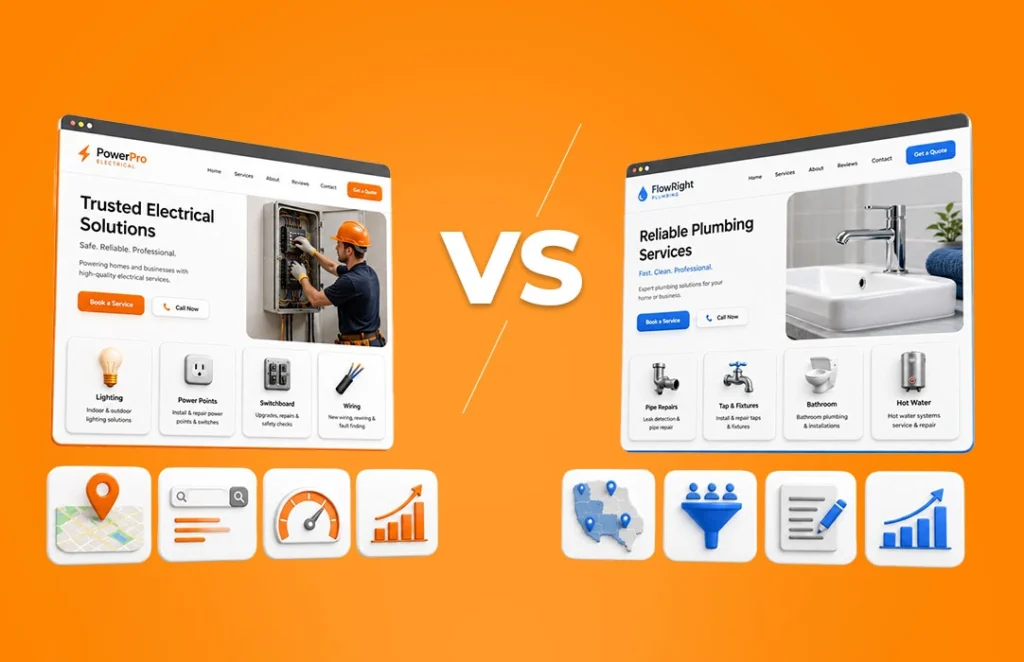
Electricians and plumbers both rely on local search, but the strategies should not be identical. Plumbers win on emergency intent, speed and round-the-clock availability, so their SEO leans on emergency keywords, fast mobile pages and 24/7 signals. Electricians earn more from planned, compliance-driven and commercial work, so their SEO leans harder on service depth, licensing content and a broader keyword mix. Same tools, different priorities.
Walk into any conversation about trade SEO, and you will hear the same line: local SEO works the same for every tradie. It is a tidy idea and it is wrong. A plumber and an electrician serve different customer moments, chase different job values, and answer to different licensing rules. Treat their SEO the same and one of them ends up with a strategy built for the other trade's customer.
This guide breaks down where the two trades diverge, and what that means for how you actually build a campaign. If you run either business in Sydney or the Parramatta area, this is where a generic tradie playbook quietly costs you jobs.
Do electricians and plumbers really need different SEO?
Yes. The foundations are shared, but the priorities are not.
Both trades depend on the Google Map Pack, both need a complete Google Business Profile, both need reviews, and both need a fast website. That part is genuinely the same, and any good SEO strategy for a Sydney business starts there.
Where they split is in the shape of demand. Plumbing search is dominated by the person standing in an emergency. Electrical search is a wider spread across urgent faults, planned upgrades, compliance jobs and commercial contracts. That single difference ripples through keywords, content, schema, reviews and even your opening hours. Build the campaign around the wrong demand shape and you rank for searches that do not match the work you want.
The core difference: emergency intent vs planned work
The clearest way to see the split is to look at what makes each phone ring.
A burst pipe, an overflowing toilet or no hot water in winter sends someone to Google in a panic. They are not comparing three quotes. They are calling whoever appears first and picks up. A large share of plumbing revenue sits in that moment, which is why plumbing SEO is built around being the fastest, most visible, most obviously available option the second someone searches.
Electrical work has its emergencies too: a tripped switchboard, a burning smell, a total power loss, but a bigger slice of an electrician's revenue comes from planned and considered jobs. Switchboard upgrades, downlight installs, ceiling fans, EV chargers, solar connection, safety inspections, rewiring during a renovation, and commercial fit-outs. These customers research first, compare, and often book days or weeks ahead.
Here is the split in one view.
| Factor | Plumbers | Electricians |
| Dominant search intent | Emergency, "now" | Mixed: emergency, plus planned and commercial |
| Highest-value quick jobs | Burst pipes, blocked drains, and hot water | Switchboard upgrades, EV chargers, rewires |
| Decision speed | Minutes | Minutes for faults, days or weeks for projects |
| 24/7 availability signal | Critical | Useful but not decisive |
| Compliance angle | Gas, backflow, certificates of compliance | Level 2 ASP, safety certificates, standards |
| Commercial and strata share | Smaller for many operators | Often significant |
| Seasonal spikes | Cold snaps, storms, blocked drains | Storms, blackouts, heatwaves, aircon loads |
Neither trade is only an emergency or only planned. The point is the ratio, and the ratio should shape your strategy.
How keyword strategy should differ
Both trades use the same "service plus suburb" backbone, "electrician Parramatta", "plumber Blacktown". The difference is what you build around it.
For plumbers, weight your keywords toward emergency and problem-first searches. "Emergency plumber Parramatta", "burst pipe repair near me", "blocked drain Penrith", "no hot water plumber Sydney", "24 hour plumber". These convert fast and they should map to dedicated, fast-loading pages with a tappable phone number at the top.
For electricians, keep a set of emergency terms, but spread wider into planned and commercial intent. "Switchboard upgrade Sydney", "EV charger installation Parramatta", "level 2 electrician near me", "commercial electrician Western Sydney", "safety switch installation", "office fit out electrician". These searchers are comparing, so the page needs to build trust and explain the job, not just shout a phone number.
The reason this matters: if an electrician pours the whole budget into "emergency electrician" terms, they miss the higher-value planned and commercial work that actually pays better and faces less price pressure. If a plumber over-invests in long educational content, they can be slow to capture the emergency calls that make up the bulk of their revenue. Getting this mix right is the heart of any real SEO strategy in Sydney.
Why compliance and licensing content weigh differently
Trust signals matter for both trades, but the specific credentials customers search for are different, and the ones with safety implications carry the most weight.
Plumbers deal with gas fitting, backflow prevention and certificates of compliance. Gas work in particular is a licensed, safety-critical area, and customers searching "licensed gas fitter Parramatta" want to see the licence before they call. Pages covering gas, backflow and compliance certificates should display the relevant credentials clearly.
Electricians have their own high-trust searches, and in New South Wales, the big one is Level 2. A Level 2 Accredited Service Provider can work on the connection between the network and the property, which a standard electrician cannot. "Level 2 electrician" is a high-intent, high-trust search term with real revenue behind it, and it deserves its own dedicated page. Safety inspections, compliance certificates and switchboard compliance are also strong trust-led searches.
The takeaway is the same for both: build pages around the credentials your customers actually search for. But the credentials differ, so the pages differ. A copy-paste trade template will miss the terms that matter most for each.
Commercial and strata work: a bigger organic play for electricians
Most residential plumbing demand is homeowner and emergency-led. Electricians, by contrast, often have a meaningful commercial and strata side: office fit-outs, retail, body corporate maintenance, data and lighting for businesses.
Commercial searches behave differently from "near me" emergencies. A facilities manager searching "commercial electrician Western Sydney" or "strata electrician Parramatta" is researching a supplier, not calling in a panic. That work suits dedicated commercial service pages, case studies and content that speaks to businesses rather than homeowners.
For an electrician, ignoring this is leaving a whole revenue stream off the table. For many plumbers, the residential emergency focus is genuinely where the money is, so the same commercial push would be a distraction. Different trades, different priorities.
Google Business Profile: same tool, different setup
Your profile is the single biggest local ranking lever for both trades, but the setup should not be identical.
The primary category is the strongest signal you control. A plumber sets "Plumber". An electrician sets "Electrician". Simple so far. The divergence is in the secondary categories and services.
- Plumbers should add secondary categories such as Drainage Service, Gas Fitting Service, Hot Water System Service, and Emergency Plumber where genuinely offered, and list emergency and blocked drain services prominently.
- Electricians should add categories such as Electrical Installation Service, Electrician, and, where relevant, Solar Energy Contractor, plus services that reflect switchboards, EV chargers, safety inspections and commercial work.
Opening hours are where the trades split hardest. Google increasingly favours businesses marked open at the moment of the search. For a plumber chasing 2 am burst-pipe calls, accurate 24/7 hours are close to essential, because "open now" and "24 hour" searches are a core part of the demand. For an electrician whose emergency share is smaller, genuine 24/7 hours help, but are not the make-or-break signal they are for plumbing. Only claim the hours you actually cover.
If you are not sure your profile is set up for the work you want, that is exactly the kind of thing our local SEO service audits first.
Schema markup and technical setup
The technical fundamentals are shared: fast mobile pages, click-to-call above the fold, LocalBusiness structured data, suburb pages and clean site architecture. But two details differ.
Schema type. Use the specific type Google recognises for each trade. A plumbing site should use the Plumber schema, and an electrical site should use the Electrician schema. It is a small thing that tells search engines exactly what the business is.
24/7 opening hours in schema. For plumbers, marking genuine round-the-clock availability in the opening hours field can trigger an "Open 24 hours" display in results, which answers the emergency searcher's biggest question before they click. For electricians, this is only worth doing if the after-hours service is real.
Mobile speed matters enormously for both, because both get searched on phones in a hurry. A slow page loses the plumbing emergency call and the electrician's planned enquiry alike.
Reviews: the language that earns relevance differs
Both trades need a steady, recent flow of Google reviews. The nuance is in what those reviews say.
Reviews carry keyword relevance, so the words customers use help you rank for those services. A plumbing business benefits from reviews that mention "emergency blocked drain in Harris Park" or "fixed our hot water same day". An electrical business benefits from reviews that mention "switchboard upgrade in Castle Hill", "EV charger install" or "Level 2 connection". Both should encourage happy customers to mention the specific job and the suburb, but the target phrases differ because the services differ.
Recency and steadiness beat raw volume for both. A trickle of genuine new reviews every week outperforms a big pile that all arrived two years ago.
Seasonality: plan content around different calendars
The two trades spike at different times, and content planned captures those spikes.
- Plumbers see surges around cold snaps (burst pipes, hot water failures) and heavy rain and storms (blocked and overflowing drains, stormwater issues).
- Electricians see surges around storms and blackouts (fault repairs, switchboard damage) and heatwaves (air conditioning load, tripping circuits), plus steadier planned demand around renovation and solar seasons.
Publishing seasonal guides ahead of these peaks, rather than during them, is how you rank when the searches arrive. A broader digital marketing strategy ties this content calendar to the rest of your marketing so it is not an afterthought.
What both trades still have in common
To be clear, most of the machinery is shared. Both electricians and plumbers need:
- A complete, active Google Business Profile with the correct primary category
- The Map Pack is the top priority, because that is where trade searchers click
- Dedicated service pages, one per core service, not a single "services" page
- Suburb pages with genuine local detail for each area served
- Fast, mobile-first websites with click-to-call
- A steady flow of recent, specific Google reviews
- Consistent name, address and phone details across the major directories
The mistake is stopping at "they're both tradies" and running one identical plan. The foundation is shared. The emphasis is not.
Where Digitalzoop fits in
We are based in Parramatta and work with trade businesses across Parramatta, Blacktown, Penrith, Castle Hill, Bankstown, Campbelltown, Liverpool and the rest of Greater Sydney. We do not hand electricians and plumbers the same template. We build the keyword mix, service pages, profile setup and content calendar around the actual shape of your demand, whether that is 2 am emergencies or planned commercial contracts.
You deal directly with the senior person doing the work, not an account manager passing messages along, and there are no lock-in contracts. If you want a straight read on whether your current SEO is built for your trade or someone else's, get in touch and we will tell you what is actually holding you back.
Frequently asked questions
Is SEO the same for electricians and plumbers?
The foundations are the same, but the strategy should not be. Plumbing SEO leans on emergency keywords and 24/7 availability, while electrical SEO leans on planned, compliance and commercial work. Same tools, different priorities.
Which trade is harder to rank for in Sydney?
Both are competitive in Sydney and the Parramatta area. Plumbing emergency terms are fiercely contested and fast-moving, while electrical work spreads across more keyword types, which can make it easier to find lower-competition entry points to rank for first.
Should a plumber or electrician run Google Ads as well as SEO?
Often yes, especially early on. Ads deliver calls immediately while SEO builds an organic asset that keeps working without a cost per click. Most trades reduce ad spend as their organic rankings mature.
How long does trade SEO take to work in Sydney?
Google Business Profile and review improvements can lift Map Pack calls within four to eight weeks. Ranking for competitive suburb and service terms usually takes three to six months of consistent work, longer for high-volume city-wide terms.
Do I need a separate page for every service and suburb?
Yes. Google ranks pages, not whole sites, so a dedicated page for each core service and each suburb you serve captures far more searches than a single overview page. Each page needs genuine, specific content rather than a template with the name swapped.
Ready to build SEO around your trade, not a template?
Whether you run an electrical business chasing planned and commercial work, or a plumbing business that lives on emergency calls, the strategy should match your demand. Call 1300 915 535, email info@digitalzoop.com.au, or book a free visibility review and we will show you exactly where you rank across Sydney right now and what it will take to get more of the jobs you actually want.