
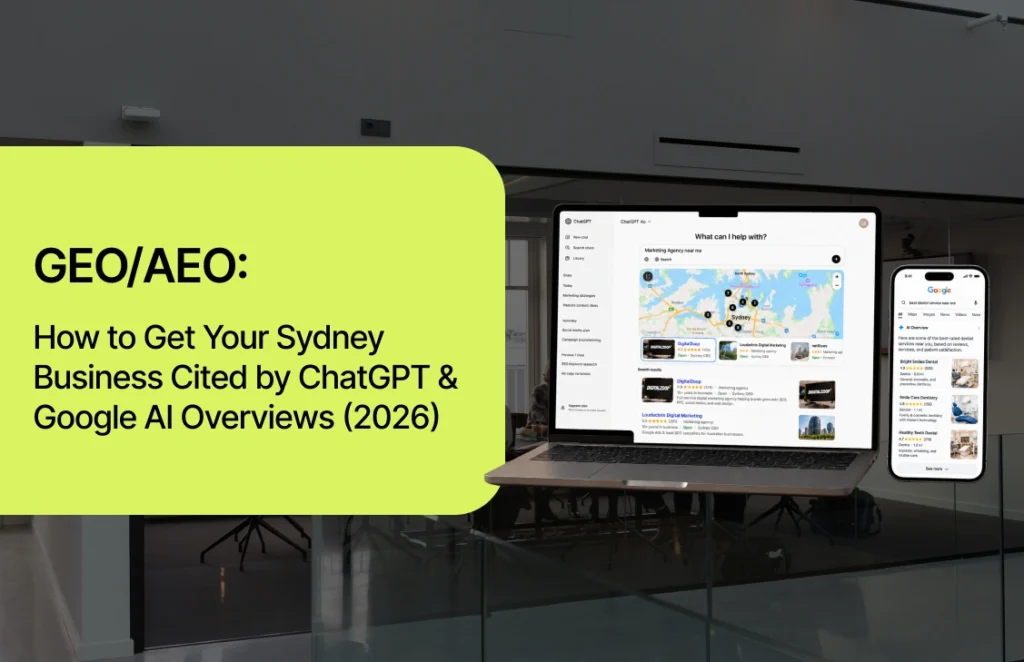
More Sydney buyers now start their search by asking a question instead of typing a keyword. They ask ChatGPT who the best provider is. They read the AI Overview at the top of Google before they ever scroll to a website. If your business is not named in those answers, you are missing the moment when the decision gets made.
Generative engine optimisation is how you fix that. In this guide, we explain what GEO and answer engine optimisation actually involve, what Google's content policy and spam updates mean for the way you produce this content, and the practical steps a Sydney business can take over the next 90 days to start earning citations in AI answers.
What Is Generative Engine Optimisation?
Generative engine optimisation (GEO) is the practice of structuring your website, content, and wider digital footprint so that AI systems such as ChatGPT, Gemini, Perplexity, and Google AI Overviews can find your business, understand it correctly, and cite or recommend it when answering a relevant question.
Answer engine optimisation (AEO) sits alongside it. AEO focuses on the answer surfaces inside traditional search, mainly Google AI Overviews and featured snippets, where a direct answer appears above the standard results. In practice, the two overlap heavily, and most of the work you do for one strengthens the other. Some marketers group all of this under AI SEO or generative search optimisation. The labels vary, but the goal is the same: be the business the answer names.
The important shift to understand is this. Traditional SEO competes for a position in a list of ten links. GEO SEO competes for a mention inside a single generated answer that might only name two or three businesses. The margin for being almost good enough has disappeared.
How Is GEO Different From SEO and AEO?
The three disciplines share foundations but aim at different targets. Here is how they compare for a Sydney business deciding where to put its budget.
| SEO | AEO | GEO | |
| Where you appear | Google and Bing organic results | AI Overviews, featured snippets, People Also Ask | ChatGPT, Gemini, Perplexity, Copilot answers |
| What wins | Relevance, links, technical health | Direct, well-structured answers to specific questions | Entity clarity, consistent mentions, citable content |
| How success is measured | Rankings, clicks, organic traffic | Snippet and Overview appearances, impressions | Brand citations, accurate descriptions, referral quality |
| Typical buyer stage | Researching options | Seeking a quick answer | Asking for a recommendation |
None of these replaces the others. A site with weak technical SEO will struggle in AI answers too, because most generative systems still lean on search indexes to retrieve their sources. The businesses winning in 2026 treat SEO as the foundation and layer AEO and GEO work on top.
What Do Google's Content Policy and Spam Updates Mean for GEO?
This is the part most guides skip, and it matters more than any tactic on this page.
Google's spam policies now explicitly target scaled content abuse: producing large volumes of pages primarily to manipulate rankings rather than help people, regardless of whether a human or an AI wrote them. The policies also cover site reputation abuse (publishing third-party content on an established site to trade on its authority) and expired domain abuse. These policies were tightened substantially from the March 2024 core update onward, and enforcement has continued through subsequent spam updates.
The practical takeaway for Sydney businesses is straightforward:
Google does not penalise AI-assisted content. It penalises unhelpful content produced at scale. Its guidance has been consistent since the helpful content system was folded into the core algorithm: content should be made for people first, demonstrate genuine experience and expertise, and exist because it helps someone, not because a keyword tool suggested it.
That creates a real irony for anyone chasing AI citations. The lazy shortcut, pumping out dozens of thin AI-written pages to blanket every query, is exactly the behaviour Google's spam policies are built to catch. Sites hit by scaled content enforcement lose organic visibility, and because generative engines retrieve heavily from search indexes, they lose AI visibility along with it.
So the compliance rules for GEO in 2026 look like this:
- Publish for a reader, not a crawler. Every page needs a clear purpose a human would recognise.
- Show first-hand experience. Real project details, local knowledge, and specific observations from your own work are what separate citable content from generic filler.
- Keep volume proportionate. Ten genuinely useful pages beat one hundred thin ones, and they carry none of the spam risk.
- Keep your author and business details visible. Clear attribution, contact details, and an about page support the trust signals both Google and AI systems check.
Do GEO this way and you are not gaming anything. You are simply becoming the most legible, most trustworthy source in your category, which is what both Google's policies and AI retrieval systems reward.
How Do ChatGPT and Google AI Overviews Choose Which Businesses to Cite?
Generative engines do not keep a directory you can submit to. When someone asks ChatGPT for the best pest control company in Western Sydney, the system typically runs a live search, retrieves a handful of pages it judges relevant and trustworthy, and composes an answer from them. Google AI Overviews work similarly, drawing on pages Google already ranks and trusts for the query.
Across both, a few patterns hold consistently:
- Clear entities get cited. If your site states plainly who you are, what you do, where you operate, and who you serve, an AI system can repeat that with confidence. Ambiguity gets you skipped.
- Consistency across sources builds confidence. When your website, Google Business Profile, directories, and reviews all describe the business the same way, retrieval systems treat you as a settled fact rather than a guess.
- Question-shaped content gets retrieved. Pages with headings that mirror how people actually ask, followed by direct answers in the first sentence or two, map neatly onto the prompts users type.
- Structured data helps machines read you. Schema markup for your organisation, services, FAQs, and local business details gives AI systems a machine-readable version of your key facts.
- Third-party mentions matter. Being named in industry publications, local directories, and review platforms gives generative engines corroborating sources beyond your own site.
Notice what is missing from that list: tricks. No meta tag forces a citation. ChatGPT SEO, as some call it, is really just disciplined clarity applied everywhere your business appears online.
How Can a Sydney Business Get Cited in AI Answers?
Here is the work, in the order we run it for clients.
1. Fix your entity signals first
Audit every place your business is described: your website, Google Business Profile, social profiles, and directory listings. Your business name, services, service areas, and contact details should match everywhere. From our own audit work, mismatched or outdated descriptions across these sources are the single most common reason a solid local business gets misdescribed or ignored by AI systems.
2. Deploy structured data properly
At minimum: Organisation and LocalBusiness schema sitewide, Service schema on service pages, FAQPage schema on genuine FAQ content, and BreadcrumbList for site structure. Validate everything, because broken markup is worse than none.
3. Rebuild key pages around real questions
Take your most commercially important pages and restructure them so each major section heading is a question your customers actually ask, answered directly in the opening lines. This is the core of answer engine optimisation, and it doubles as better content for human visitors who skim.
4. Publish content only you could write
Generic explainers are everywhere, and AI systems have no reason to cite the fiftieth version of one. Content grounded in your own projects, your suburb-level knowledge, and problems you have personally solved is scarce, and scarcity is what earns citations. It is also precisely what Google's helpful content signals reward.
5. Build corroborating mentions
Pursue listings in reputable Australian directories, local business associations, and industry publications. Encourage detailed Google reviews that mention specific services and suburbs. Each consistent third-party mention is another source an AI system can retrieve when deciding whether to name you.
6. Keep your technical foundation clean
Fast pages, crawlable structure, correct canonicals, and a healthy sitemap remain prerequisites. If Google cannot index you reliably, generative engines that lean on search indexes cannot retrieve you either. A technical and local search foundation is where every GEO engagement should start.
Does Local SEO Still Matter for AI Search?
For Sydney businesses, it matters more than ever. When someone asks an AI assistant for a plumber in Parramatta or an accountant near Castle Hill, the systems reach for local signals: Google Business Profile data, review patterns, suburb mentions in content, and local citations.
We see this constantly in Greater Sydney work. Businesses with a well-maintained profile, genuine suburb-specific service pages, and steady reviews get named in AI answers for local queries even when their broader domain authority is modest. Businesses with a neglected profile get skipped, however good their website copy is.
If you serve Parramatta, Blacktown, Penrith, Liverpool, or anywhere across Western Sydney, your local search presence is now doing double duty: it feeds the Map Pack and it feeds the AI answer. Our Parramatta SEO service treats both as one job, because that is how the systems treat them.
What Does a 90-Day GEO Plan Look Like?
You do not need to do everything at once. Here is a realistic sequence for a Sydney small or mid-sized business.
Days 1 to 30: Audit and foundations
- Run an entity audit across your site, Google Business Profile, and top directories, and fix every inconsistency
- Validate and repair existing schema, then add Organisation, LocalBusiness, and Service markup
- Test your current AI visibility: ask ChatGPT, Gemini, and Perplexity the recommendation questions your customers would ask, and record whether you are named and described accurately
Days 31 to 60: Content restructure
- Rework your top five commercial pages with question-led headings and direct answers
- Add genuine FAQ sections with FAQPage schema to your key service pages
- Publish one substantial piece grounded in first-hand experience, targeting a question your prospects ask AI assistants
Days 61 to 90: Authority and measurement
- Secure or correct listings in the major Australian directories relevant to your industry
- Build a review generation habit that produces steady, specific Google reviews
- Re-run your AI visibility tests, compare against the day-one baseline, and set a monthly repeat
This sequencing keeps every action inside Google's content policies while steadily improving how AI systems read your business. It also slots naturally into a broader digital marketing strategy rather than sitting off to the side as an experiment.
How Do You Measure AI Search Visibility?
There is no single dashboard for this yet, but a business owner can track it with a simple monthly routine:
- Citation testing. Ask the same set of recommendation prompts across ChatGPT, Gemini, and Perplexity each month. Note whether you are named, whether the description is accurate, and who else appears.
- AI Overview presence. Search your priority queries in Google and record whether an AI Overview appears and whether your site is among its sources.
- Referral signals. Watch your analytics for referral traffic from AI platforms and for direct traffic spikes that follow branded mentions.
- Branded search volume. Growth in people searching your business name often follows AI recommendations, since many users see the answer and then search the brand.
Keep it in a simple spreadsheet. The trend over quarters tells you far more than any single month.
Why Sydney Businesses Choose Digitalzoop for GEO and AEO
GEO rewards the same things we have always built for clients: clear positioning, honest content, sound technical foundations, and a strong local presence across Greater Sydney. We fold AI search visibility into our SEO engagements rather than selling it as a bolt-on, because the work is the same discipline applied to a new surface.
You work directly with our senior team; there are no lock-in contracts, and we report on what actually moves: citations, rankings, enquiries, and revenue. If you want to know how visible your business currently is to ChatGPT and Google AI Overviews, talk to us, and we will show you your baseline before you spend a dollar.
Frequently Asked Questions
What is generative engine optimisation in simple terms?
It is the work of making your business easy for AI systems like ChatGPT and Google AI Overviews to find, understand, and recommend. That means clear information about who you are and what you do, structured data machines can read, and content worth citing.
Does Google penalise AI-generated content?
No. Google's spam policies target unhelpful content produced at scale to manipulate rankings, whoever wrote it. AI-assisted content that is accurate, useful, and grounded in real experience is fine under Google's content policy.
How long does it take to appear in AI answers?
Most businesses see their first accurate mentions within three to six months of consistent work, depending on their starting authority and competition. Local recommendation queries often move faster than broad national ones.
Can I do GEO myself or do I need an agency?
The basics, such as fixing your Google Business Profile, tidying inconsistent listings, and adding FAQ content, are achievable in-house. Schema implementation, entity strategy, and content restructure at scale usually justify professional help.
Is AEO different from ranking in featured snippets?
They are closely related. Featured snippet optimisation was the original form of answer engine optimisation, and AI Overviews now sit above snippets using similar retrieval logic. Content structured to win snippets is well positioned for Overviews too.