
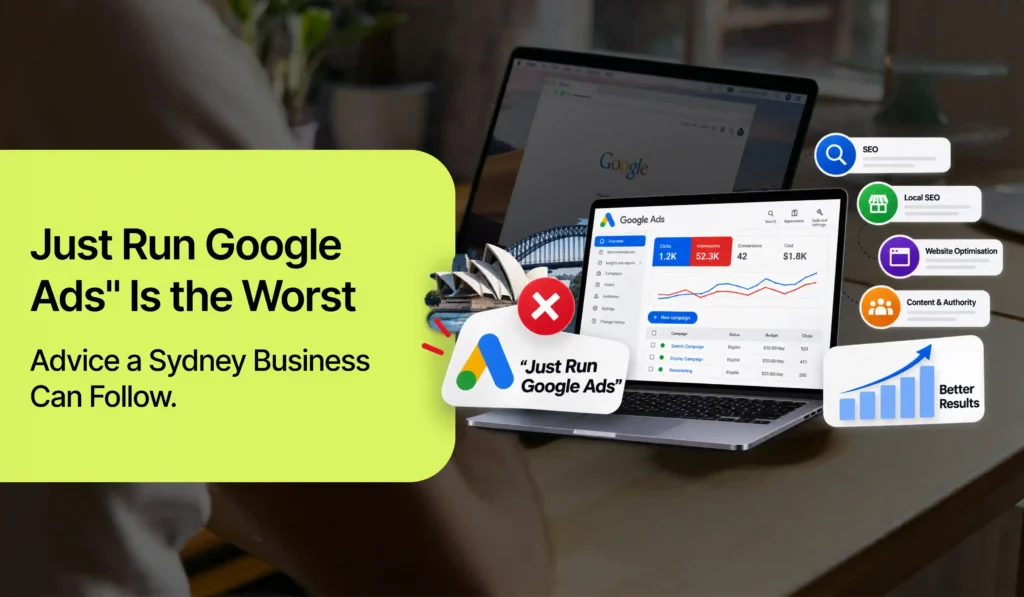
Google Ads works. That is not the problem. The problem is the word "just". When a mate, an accountant or a sales rep tells a Sydney business owner to just run Google Ads, they are prescribing a powerful tool with none of the conditions that make it profitable: conversion tracking, a page built to convert, sensible campaign settings, and numbers that prove each lead costs less than it earns. Followed literally, the advice produces the most common story we hear from new clients: thousands of dollars spent, a report full of clicks, and a phone that barely rang.
The Digitalzoop team manages Google Ads for small business clients across Greater Sydney, so this is not an anti-ads article. It is an anti-"just" article. Below is what the advice leaves out: what clicks actually cost in this city, the five ways unprepared campaigns burn money, when ads genuinely are the right move, and what needs to exist before you hand Google a dollar.
Why everyone hands out this advice
The advice spreads because it contains real truth. Ads are fast, and speed is seductive when the pipeline is empty. Results are measurable in a way that word of mouth never was. And Google itself makes starting effortless: a credit card, a few prompts, and your ad is live by dinner.
What the advice skips is that Google Ads is an auction against every competitor in your market, run on settings that default in Google's favour, judged by a machine that optimises toward whatever you tell it to count. Businesses that enter that auction unprepared do not get average results. They fund the results of the businesses that came prepared.
What clicks actually cost in Sydney
Sydney runs some of the most expensive keyword auctions in the country. Clicks for trades and home services commonly land in the range of ten to thirty dollars; legal and financial keywords can exceed fifty dollars per click, and even modest service niches rarely see clicks under a few dollars. Now run the arithmetic the advice never mentions: at fifteen dollars a click and a website that converts two per cent of visitors, one enquiry costs seven hundred and fifty dollars before you have won the job. At a five per cent conversion rate, the same enquiry costs three hundred dollars. The single biggest profit lever in Google Ads is not inside Google Ads at all. It is what happens after the click.
Five ways "just run ads" burns money
1. No conversion tracking, so nobody knows what works. A remarkable share of the small business accounts we audit measure nothing beyond clicks. Without tracking calls, forms and quote requests, Google's automated bidding optimises blind, the budget drifts toward keywords that generate traffic rather than customers, and the monthly report answers the wrong question. Tracking is not an optional extra. It is the difference between advertising and donating.
2. Clicks sent to a homepage that was never built to sell. Paying premium Sydney prices to land visitors on a generic homepage, or worse, a slow one, wastes most of the spend before a human ever judges your offer. Every campaign needs a dedicated page that matches the ad's promise, loads fast on mobile, states the offer plainly and makes contact effortless. Many of the conversion killers are the same problems we documented in our analysis of Sydney business websites, and ads simply make you pay to expose them.
3. Google's defaults, left switched on. Broad match keywords, auto-applied recommendations, Display Network expansion and no negative keyword list form the default configuration of a new account, and every one of those defaults spends more of your money, faster, on less relevant searches. Unmanaged accounts routinely pay for clicks from the wrong suburbs, the wrong intent and the wrong searches entirely, and the owner only discovers it if someone reads the search terms report. In most burnt-budget accounts we take over, nobody ever had.
4. No unit economics behind the budget. "Just run ads" never asks what a customer is worth. If your average job brings in four hundred dollars of margin and your true cost per acquisition is three hundred and fifty, the campaign is a treadmill. If a customer is worth thousands over several years, a higher acquisition cost is a bargain. Until you know your numbers, no budget figure means anything, and no result can be judged.
5. Ads as the only channel, forever. Paid search is rented visibility. The moment spending stops, so do the leads, which is fine as a strategy and dangerous as the strategy. Businesses that pour everything into ads for years often end up with strong campaign data, zero organic presence, and a marketing cost that rises every time a competitor enters the auction.
So, is Google Ads worth it?
For many Sydney small businesses, genuinely yes, under conditions. Ads are worth it when the maths works after honest tracking, when the searches you target carry buying intent, when your landing experience converts, and when someone competent watches the account. Ads are the right lead channel when you are new and cannot wait months for organic visibility, when you need enquiries during seasonal peaks, when you are testing a new service or suburb, and when you are contesting emergency and urgent searches where the top of the page wins the call.
Ads are not worth it as a patch for a weak website, a substitute for a sales process, or a set-and-forget machine. The platform amplifies what you feed it. Feed it a broken funnel and it will scale the breakage at fifteen dollars a click.
Google Ads vs SEO is the wrong fight
Most advice frames this as Google Ads vs seo, a choice between renting visibility and building it. The framing is the mistake. The seo vs ppc question has a boring, profitable answer for most established businesses: run both, in the right sequence, letting each feed the other. Ads deliver enquiries now and generate keyword and conversion data that sharpens your content strategy. Organic work compounds in the background until it carries the baseline, letting paid budget concentrate on the searches worth paying for. We break down the sequencing decision in detail in our guide to SEO vs Google Ads for Sydney businesses, including which channel deserves the first dollar at each business stage.
The one wrinkle worth adding for 2026: search itself is fragmenting, with AI answers absorbing a growing share of queries. Businesses building organic and local SEO strength alongside their ads are the ones showing up in those answers too. Businesses that only ever bought clicks are invisible there at any budget.
Before you spend a dollar: the readiness checklist
Here is what we require before launching Google Ads for small business clients, and what you should demand of yourself or any provider:
- Know your numbers. Average job value, margin, and the maximum you can pay for a lead while staying profitable
- Conversion tracking installed and tested. Calls, forms and quote requests, all firing correctly, before the first click
- A landing page built for the campaign. Fast, mobile-first, matched to the ad, with one clear action
- A keyword plan with intent. Buying searches, not research searches, mapped suburb by suburb for your service area
- Negative keywords from day one. The list of searches you refuse to pay for matters as much as the list you target
- Location and schedule settings that match reality. Your actual service suburbs, your actual answering hours
- A measurement rhythm. Weekly search term reviews early on, and a monthly report that talks about cost per enquiry, not clicks
A campaign that cannot tick all seven is not ready, and no amount of budget fixes unreadiness.
DIY, consultant or agency?
Small budgets under roughly a thousand dollars a month can be run by an owner willing to learn, provided the checklist above is met and the search terms report gets read. Beyond that, the arithmetic usually favours help: a capable google ads expert Sydney businesses can actually reach will typically recover their fee in eliminated waste alone, because the most expensive person on any account is the one who does not know what the defaults are doing.
Choosing that help deserves the same scepticism as the ads themselves. A genuine google ads consultant Sydney operators can trust will ask about your margins and your capacity before your budget, show you the account rather than hiding behind dashboards, and never guarantee positions. Whether you engage a freelancer or a ppc agency Sydney based or otherwise, insist on owning your own account, seeing the search terms, and reporting built on cost per enquiry. Anyone offering google ads management Sydney wide who resists any of those three is telling you how the engagement will go.
The honest version of the advice
"Just run Google Ads" should really be: know your numbers, fix the page, install tracking, target intent, kill the defaults, watch the search terms, and build organic visibility alongside so you are not renting forever. That version is less catchy and considerably more profitable.
Digitalzoop runs Google Ads and SEO as one system for small businesses across Greater Sydney, with conversion tracking as a launch requirement, itemised deliverables, reporting on cost per enquiry, no lock-in contracts and direct access to the senior team managing the account. If your ads are spending without selling, talk to us and we will show you exactly where the budget is leaking.
Frequently asked questions
Is Google Ads worth it for small businesses?
Yes, when the foundations exist: accurate conversion tracking, a landing page that converts, intent-driven keywords and profitable unit economics. Without those, ads reliably spend money without producing customers, regardless of budget.
How much should a Sydney small business spend on Google Ads?
Enough to buy meaningful data in your market, which for most Sydney service industries means at least one to two thousand dollars a month in ad spend. Below that in expensive auctions, campaigns rarely generate enough clicks to optimise anything.
Why is my Google Ads campaign not getting results?
The usual culprits are missing conversion tracking, broad match keywords without negatives, clicks landing on a weak page, and bidding optimised for traffic instead of enquiries. Reading the search terms report typically reveals the waste within minutes.
Should I do SEO or Google Ads first?
It depends on cash flow and timeline. Ads deliver enquiries within days but stop when spending stops, while SEO takes months and compounds. Most established Sydney businesses get the best result running ads for immediate leads while building organic visibility in parallel.
Do I need a Google Ads expert or can I manage it myself?
Small, simple campaigns can be self-managed if you learn the platform and review search terms weekly. Once spend grows or competition is fierce, professional management usually pays for itself by eliminating wasted spend the defaults create.