
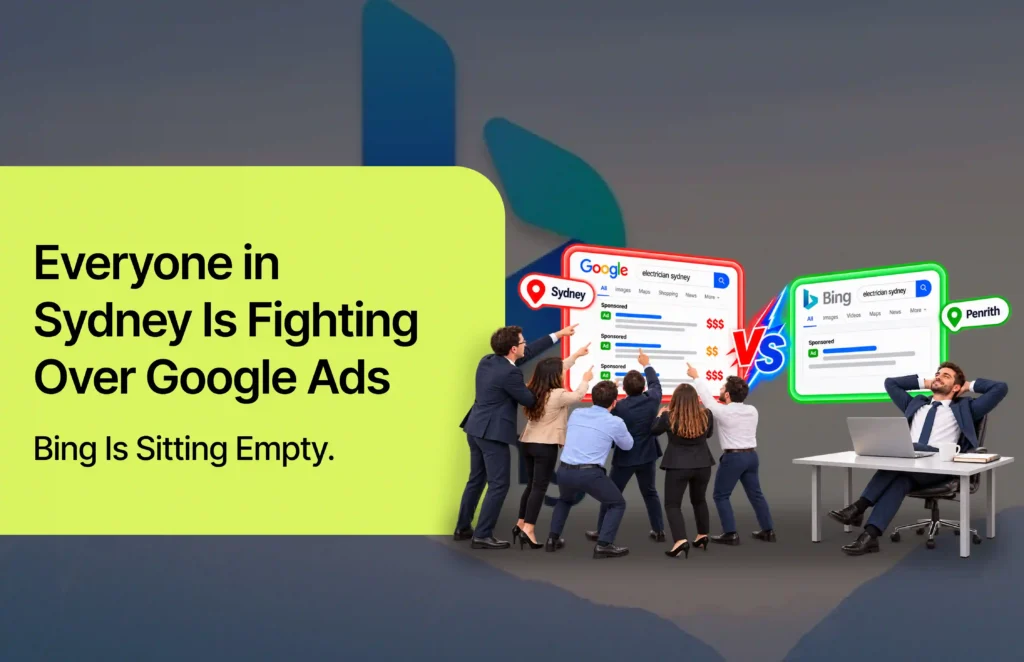
Let's be precise about the claim, because precision is the whole point. Bing is not empty of searchers. The Microsoft Search Network carries roughly five to nine per cent of Australian searches, weighted heavily toward desktop, and the people behind those searches skew older, wealthier and more professional than the average. What Bing is empty of is competitors. While every plumber, lawyer and retailer in Sydney bids against each other in the same Google auctions, pushing clicks to brutal prices, the same keywords on Microsoft Ads routinely cost 20 to 40 per cent less, because most of your competitors have never logged in.
That is the entire opportunity in one paragraph: the same searchers, the same intent, a fraction of the auction pressure. The Digitalzoop team runs Microsoft Ads alongside Google for Sydney businesses, and this article covers who is actually on Bing in Australia, what bing ads cost compared to Google, the honest decision framework for whether the channel deserves your budget, and the one-hour setup that gets a proven Google account earning a second time.
Why Sydney's Google Auctions Got So Expensive
Google Ads works, which is exactly the problem. Every business in the city knows it works, so Sydney runs some of the most contested keyword auctions in the country: trades and home services clicks commonly land between ten and thirty dollars, and legal or financial keywords can pass fifty dollars per click. We unpacked what that does to unprepared budgets in our piece on why "just run Google Ads" is the worst advice a Sydney business can follow, and the short version is that auction pressure keeps rising while the number of customers does not.
When an auction gets crowded, the smart moves are to bid better or to find the queue nobody is standing in. Microsoft Ads is the second one.
Who Is Actually Searching on Bing in Australia?
The reflex objection is "nobody uses Bing", and it dies on contact with how Australians actually encounter the Microsoft Search Network. Every Windows computer ships with Edge as the default browser and Bing as the default search engine, and most office workers never change their work machine's defaults. That single fact shapes the audience: bing advertising reaches a disproportionately desktop-based, working-hours, 35-plus crowd, over-indexed in higher household income brackets and corporate environments. The network also extends beyond Bing itself, placing ads across Yahoo, MSN, DuckDuckGo search results and Microsoft's Copilot AI assistant.
For some Sydney businesses that profile is a shrug. For others, think financial services, legal, B2B services, healthcare, home improvement and anything bought by people over 40 with money, it describes the exact customer they pay a premium to reach on Google.
Microsoft Ads vs Google Ads: The Real Differences
The microsoft ads vs google ads comparison comes down to five practical points:
- Cost. CPCs on Microsoft typically run 20 to 40 per cent below Google for comparable keywords, because fewer advertisers are bidding. Lower click costs flow directly into lower costs per lead when the landing page holds up
- Volume. The honest trade-off. Expect somewhere around a fifth to a third of your Google search volume for the same keywords, which is why Microsoft works as an addition to Google, not a replacement
- Targeting nobody else has. Microsoft Ads can target by LinkedIn profile data: company, industry and job function. For B2B campaigns, no other search platform offers anything close, and most B2B advertisers in Sydney have never used it
- AI placements. Ads appear inside Copilot, Microsoft's AI assistant, reaching people mid-research in a conversational context. Microsoft's own published data reports dramatically higher engagement for these placements than traditional search ads
- Setup cost. Near zero if you already run Google Ads, because Microsoft imports your campaigns, keywords and ads almost wholesale. Your proven account earns twice
The platforms are more alike than different in daily management, which is why the channel is such an easy expansion for anyone already doing google ads management sydney campaigns properly: same keywords, same ads, same discipline, cheaper auction.
What Do Bing Ads Cost?
Think of bing ppc pricing in relative terms, because absolute figures swing by industry. Whatever a click costs you on Google in Sydney, budget for the same click costing 20 to 40 per cent less on Microsoft, with some service categories seeing even wider gaps. Budget sizing follows volume: a sensible starting allocation is 20 to 30 per cent of your Google search spend, and most Sydney businesses need at least $1,000 a month in spend for the data to mean anything. Below that, the channel still works mechanically, but you will wait a long time to learn anything from it.
The metric that decides everything is the one we insist on for every paid channel: cost per lead, tracked properly, compared side by side with Google. When Microsoft delivers the same lead for 30 per cent less, the case makes itself in your own data within a quarter.
Is Bing Ads Worth It? The Honest Framework
The channel earns its place when: you already run profitable Google search campaigns and want the same leads cheaper, your customers skew 35-plus, professional or higher income, you sell B2B and can use LinkedIn profile targeting, your product is bought at a desk during work hours, or your Google CPCs have climbed to the point where a 30 per cent discount materially changes your economics.
Skip it, honestly, when: your audience is young and mobile-first, your total monthly ad budget is under roughly $1,000 so the extra channel just fragments your data, or your Google account itself is unprofitable, because importing a broken account buys the same problems at a discount. Fix the foundation first.
Notice the pattern: Microsoft Ads is a second serving of a meal that is already working. It is almost never the fix for a channel strategy that is not.
The One-Hour Start, and the Traps Inside It
Getting live is genuinely fast. Doing it properly means knowing where the import bites:
- Install the UET tag first. Microsoft's tracking tag must be on every page before anything else, or you will spend blind from day one
- Import your Google campaigns, then audit them. Structure, keywords and ads transfer well. URLs, extensions and audiences need manual checking, because not everything has a Microsoft equivalent
- Do not keep Google's bids. Imported bids priced for Google's auction overpay in Microsoft's thinner one. Cut them 20 to 35 per cent at import and let performance data adjust from there
- Rebuild conversion goals natively. Imported goals are unreliable. Recreate calls, forms and purchases inside Microsoft Ads against the UET tag
- Turn off scheduled auto-imports after setup. A recurring import can silently re-enable campaigns you paused, which is the most common way we see the channel quietly burn money
- Review the syndication partners report monthly. Ads run across partner sites of varying quality, and excluding the weak ones is routine hygiene, exactly like search terms work in Google
An account set up this way typically produces comparable-quality traffic within days, because the keywords and ads were proven on Google first.
The Copilot Angle Most Advertisers Have Not Noticed
One more reason the timing favours early movers: Microsoft is wiring advertising into Copilot, its AI assistant, faster than any competitor is monetising AI search. Ads inside AI conversations reach people mid-decision, and Microsoft's published results for these placements show engagement well above traditional search ads. We have written before about how customers are shifting toward AI assistants for recommendations in our piece on Sydney customers asking AI, and Microsoft Ads is currently the most direct paid route into that behaviour. Advertisers already on the platform inherit these placements as they expand. Advertisers still debating whether anyone uses Bing will arrive after the auction fills.
Two Queues, One Strategy
None of this argues against Google, which remains the volume engine of every paid search strategy we build as a Google Ads agency for Sydney businesses. The argument is narrower and stronger: the same keywords, ads and landing pages you have already paid to prove should earn in both auctions, and right now one of those auctions is underpriced because your competitors cannot be bothered standing in it.
Digitalzoop runs Microsoft and Google as one paid search program: shared keyword strategy, side-by-side cost per lead reporting, conversion tracking as a launch requirement on both platforms, no lock-in contracts, and direct access to the senior team doing the work. Our Microsoft Ads management takes a proven Google account live on the Microsoft network within days, and if you do not have a proven account yet, our broader PPC services build the foundation first. If your Google clicks keep getting dearer while your lead targets stay the same, talk to us and we will model exactly what your keywords would cost in the quieter auction.
Frequently Asked Questions
Is Bing Ads worth it in Australia?
For businesses already profitable on Google search, usually yes. CPCs run 20 to 40 per cent lower for the same keywords, and the audience skews older, professional and higher income. Below about $1,000 a month in budget, the extra channel rarely pays back.
How much do Bing Ads cost compared to Google Ads?
Expect clicks on the Microsoft network to cost roughly 20 to 40 per cent less than the same keywords on Google, with wider gaps in some service categories. Volume is lower too, so it works best as an addition to Google rather than a replacement.
Does anyone actually use Bing in Australia?
Yes. The Microsoft network carries roughly five to nine per cent of Australian searches, concentrated on desktop because Windows computers default to Edge and Bing. That audience over-indexes on 35-plus, higher-income and workplace searchers.
Can I just import my Google Ads campaigns into Microsoft Ads?
Yes, and it is the recommended start, with care. Install the UET tracking tag first, lower imported bids by 20 to 35 per cent, rebuild conversion goals natively, and switch off scheduled auto-imports so paused campaigns cannot silently restart.
Do I need a separate agency for Microsoft Ads?
No, and you should not want one. The channel works best run alongside Google by the same team, with one keyword strategy and one cost per lead report across both, so budget can shift to whichever auction is delivering cheaper leads.