
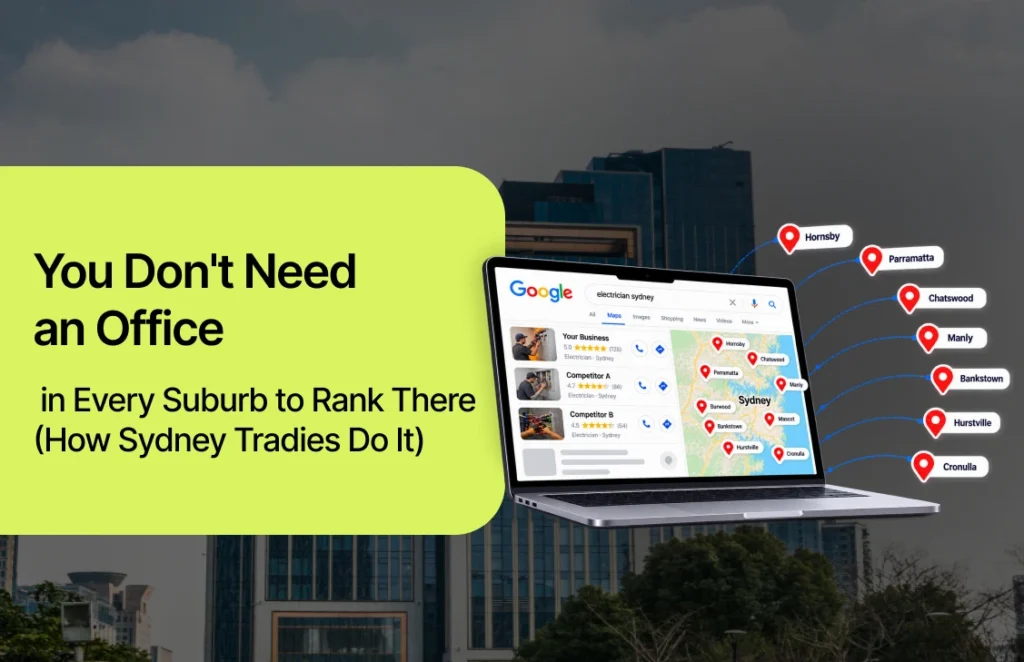
Here is the answer up front: Google does not require a physical address in a suburb for you to rank there. It requires proof of relevance. A plumber based in Penrith ranks for "blocked drain Blacktown" through three things: a Google Business Profile set up correctly as a service-area business, a genuine page on the website about their Blacktown work, and reviews from Blacktown customers saying so. No shopfront, no second office, no PO box tricks. That is the entire model, and the tradies winning searches across Western Sydney right now are running exactly this play.
The Digitalzoop team works with trade businesses across Greater Sydney, and the office myth costs them more leads than any algorithm ever has. Some tradies assume they can only rank where they park the ute each night, so they never target the suburbs next door. Others try to shortcut it with fake addresses and get their profiles suspended. This guide covers how local rankings actually work, the honest version of what SEO for tradies involves, and the exact sequence for ranking across every suburb you genuinely service.
Why Tradies Believe the Office Myth
The belief comes from a half-truth. Open Google Maps and search any trade plus suburb, and the map results do lean toward businesses physically near that suburb. Watch a competitor with a shopfront in the area sit in the map pack week after week and the conclusion writes itself: no address, no ranking.
What that conclusion misses is that a suburb search returns two sets of results, and they run on different rules. Misunderstanding the difference is the single most common mistake in local SEO for tradies, so it is worth getting right before spending a dollar on anything.
The Two Engines: Map Pack and Organic Results
The map pack (the three businesses shown with the map) runs on Google's local algorithm, which weighs relevance, distance and prominence. Distance matters here, which is the grain of truth in the myth. But Google itself states that distance is only one factor: a business with stronger relevance and prominence signals routinely outranks a closer one. For service-area businesses like tradies, "distance" is also measured against the service area you declare, not just a front door.
The organic results (the standard listings below the map) carry no proximity requirement at all. They rank whichever page best answers "hot water repairs Castle Hill", wherever that business sleeps at night. This is where suburb pages do their work, and it is the engine most tradies ignore entirely because every conversation about google maps seo starts and ends with the pin.
Win both engines and you appear twice on the same search. The rest of this guide covers each engine in turn.
Engine One: Google My Business for Tradies, Done Properly
Your Google Business Profile is the foundation of map pack visibility, and tradies have a specific configuration most guides skip:
Set up as a service-area business. If customers come to you, show your address. If you go to customers, which describes most trades, hide the address and declare your service areas instead. Google allows up to 20, covering suburbs, councils or postcodes. This is the official, penalty-free way to tell Google where you work.
Declare your real service area, not all of Sydney. Specificity wins. A profile honestly covering a cluster of suburbs sends a cleaner, more trustworthy signal than one claiming the entire metro area, and Google rewards the business it can trust about where it actually works.
Pick the most specific category. "Plumber" beats "Contractor". Add secondary categories for real services like hot water system supplier or gas fitter.
Feed it constantly. Photos of real jobs, services listed individually, questions answered, posts when you have something worth saying. A profile Google can see is alive outranks a bigger competitor's abandoned one.
Build a review rhythm with suburb names in it. A steady drip of reviews each month beats a big dusty total, and reviews that naturally mention the suburb ("fixed our switchboard in Seven Hills the same day") are relevance gold for the exact searches you want. Ask every happy customer, the same day, with a direct link.
Most tradies never get past a half-finished profile, which is why Google Business Profile management is often the fastest win in any trade campaign: the gap between a claimed profile and an optimised one is usually a competitor's entire lead flow.
Engine Two: How to Rank in Multiple Suburbs With Pages That Earn It
Organic suburb rankings come from suburb pages, and this is where quality decides everything. Google has seen a million cloned location pages with the suburb name swapped out, and it quietly ignores them. A suburb page that ranks reads like it was written by someone who has genuinely worked there, because it was:
- The services in demand in that suburb, not a generic list. Older suburbs mean older wiring and clay drainage pipes. New estates mean new builds, EV chargers and landscaping
- Proof of work there. Photos from actual jobs, a line about the streets or property types, a testimonial from a local customer with the suburb named
- Practical local detail. Response times from your base, parking or access quirks, council requirements where they genuinely differ
- The questions locals ask, answered directly in an FAQ block with schema markup
- One clear way to contact you, repeated without being obnoxious
Start with five to eight suburbs where you already work and want more jobs, build each page properly, and interlink them with your service pages. Expect new suburb pages to take roughly three to five months to rank as Google builds confidence, faster where competition is thin. Five genuine pages will outperform twenty clones every time, and clones can drag down the suburbs you already rank for. This is the same page-quality standard we apply across local SEO services Sydney wide, and it is the difference between suburb pages that compound and suburb pages that embarrass.
Once the first cluster ranks, expand outward ring by ring. That is the honest answer to how to rank in multiple suburbs: one properly-earned suburb at a time, not fifty pages generated in an afternoon.
The Glue That Holds Both Engines Together
Three signals feed the map pack and organic rankings simultaneously, which makes them the highest-return work in the whole system:
- Consistency. Your business name, phone number and service details identical across your website, profile, directories and industry listings. Inconsistency reads as unreliability to Google and to the AI tools now answering local searches
- Reviews, continuously. The monthly drip discussed above powers map rankings, convinces humans, and supplies the suburb-name mentions that connect you to places you have no address in
- Local prominence. Mentions from supplier pages, local sponsorships, community groups and industry associations. A junior footy club sponsorship with a link does more for a tradie than most purchased backlinks ever will
We cover the broader system in our local SEO guide, but for tradies these three carry most of the weight.
The Honest Limits
Credibility requires the caveat. The map pack's distance factor is real, so your map visibility is strongest near your base and your declared service area, and it thins at the edges. A Penrith plumber will struggle to crack the Bondi map pack regardless of effort, and anyone promising otherwise is selling something. The play at the edges of your patch is the organic engine, where suburb pages face no proximity penalty, plus paid ads for the urgent, emergency searches where the top of the page takes the call. Rankings in newly targeted suburbs also take months, not weeks. A provider promising every suburb in 30 days has told you everything you need to know about them.
One More Front: The Customers Asking AI
A growing share of Sydney homeowners now skip Google entirely and ask ChatGPT or other AI assistants to recommend a tradie. Those tools lean on the same signals this guide builds: consistent business details, strong reviews, and suburb pages that prove where you work. We unpacked the shift in our piece on Sydney customers asking AI for recommendations, and the short version for tradies is reassuring: do the work above properly and you are building AI visibility at the same time, while your competitors remain invisible on both fronts.
What This Costs, and When to Get Help
Everything in this guide can be done by an owner with patience: the profile in a weekend, one suburb page a fortnight, review requests as a habit. The catch is consistency, because digital marketing for tradies fails far more often from abandonment than from ignorance, and the quote-job-invoice treadmill abandons it for you. Professional help makes sense when the value of your time on the tools exceeds the cost of someone doing this properly every month, which for most established trades it does. Judge any provider of marketing for tradies by one standard: do they report enquiries and booked jobs, or do they report rankings and hope you will not ask what the rankings produced?
Rank Where You Work, Not Just Where You Park
The office myth keeps good tradies invisible in suburbs full of their own customers. The businesses winning seo for tradies Sydney searches are not the ones with the most vans or the biggest brand. They are the ones whose profile, pages and reviews prove, suburb by suburb, that they genuinely work there. Digitalzoop builds exactly that for trade businesses across Greater Sydney, with itemised monthly deliverables, reporting on enquiries rather than vanity numbers, no lock-in contracts, and direct access to the senior team doing the work. If you want to know which suburbs you could be ranking in within six months, talk to us and we will map your patch for free.
Frequently Asked Questions
Can I rank in a suburb where I don't have an office?
Yes. Organic results have no address requirement, and the map pack accepts declared service areas for businesses that travel to customers. A genuine suburb page, a correctly configured service-area profile and reviews from that suburb do the job an office never could.
Do tradies need a separate page for every suburb?
Not every suburb, and never cloned pages. Build genuine, detailed pages for the five to eight suburbs that matter most, prove real work in each, then expand. Quality suburb pages compound, while duplicates get ignored or hurt you.
How long does local SEO take for tradies?
A properly optimised Google Business Profile can lift map visibility within weeks, while new suburb pages typically take three to five months to rank. Most Sydney trade campaigns show clear enquiry growth inside one to two quarters.
Is a Google Business Profile enough on its own?
It is the single most important asset, but it only covers the map pack, and its reach weakens with distance. Suburb pages on your website carry the organic rankings, and reviews plus consistent business details power both.
Should I use a fake address to rank in another suburb?
No. Google suspends profiles with virtual offices, mate's addresses and PO boxes, and a suspension can take weeks to recover while your leads vanish. Declared service areas achieve the goal legitimately and without the risk.