
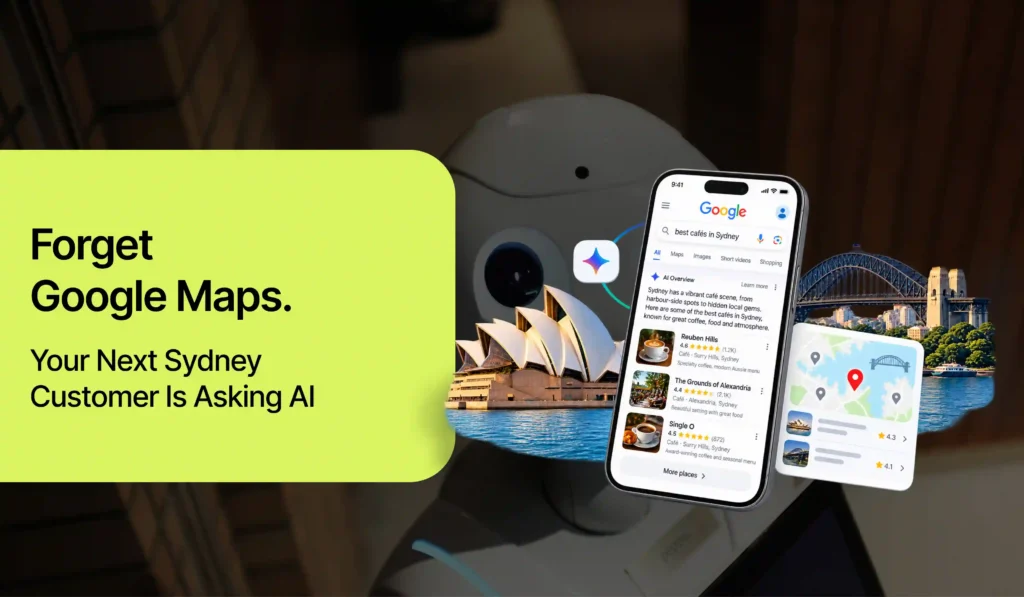
Somewhere in Sydney right now, a homeowner with a burst pipe is not opening Google Maps. They are typing "who is a reliable emergency plumber near Parramatta" into ChatGPT, and the answer comes back as three business names with a sentence about each. If your business is one of the three, you just earned a call without a single click. If it is not, you were never in the running, and no ranking report will ever show you the customer you lost.
That is the shift this article covers. Customers across Sydney are asking ChatGPT, Google's AI features, Perplexity and Gemini for local recommendations, and those tools answer with a shortlist rather than a list of links. Getting onto that shortlist is a discipline called AI search optimisation, and it works differently to the SEO most businesses have been buying. The Digitalzoop team explains what changed, how AI assistants actually decide which Sydney businesses to recommend, and the practical steps that get you into the answers.
How Sydney customers search now
Hundreds of millions of people use ChatGPT every week, and AI answers now sit at the top of a growing share of Google searches. The behaviour change matters more than the numbers: people ask AI tools full questions in plain language, describe their situation in detail, and act on the recommendation without comparison shopping. Someone who asks an assistant for "a dentist in Castle Hill that is good with anxious kids and open Saturdays" and gets a confident answer often books with that answer.
Traditional search sent you traffic to convert. AI search hands over a pre-filtered decision. That makes the economics brutal in both directions: being recommended is worth more than a top ranking ever was, and being absent is invisible in a way that never shows up in your analytics.
Before anything else: Google Maps is not dead
The headline is a provocation, so here is the honest version. The map pack still drives enormous volumes of local enquiries, and nothing in this article suggests abandoning it. What has changed is that a second front has opened. Discovery now happens in two places: the map results you have always competed for, and the AI answers you probably have not. The useful news is that the work overlaps heavily. Almost everything that makes AI systems trust your business also strengthens your map visibility, which is why our local SEO campaigns now treat the two as one program rather than separate projects.
GEO, AEO, AI SEO, LLM SEO, ChatGPT SEO: Five names, one Discipline
The industry has produced a pile of acronyms for this work, and they overwhelmingly describe the same thing:
- Generative engine optimisation (GEO) is the most widely used term: optimising so generative AI systems cite and recommend you
- Answer engine optimisation (AEO) emphasises being the answer to a question, whether in an AI response or a featured snippet
- AI SEO and AI search optimisation are the plain-English umbrella terms
- LLM SEO refers to the large language models, the technology underneath ChatGPT, Gemini and Claude, that these strategies target
- ChatGPT SEO narrows the focus to one platform, though the methods barely change between platforms
If an agency sells you geo seo and another pitches aeo seo, they are describing the same work: making your business easy for AI systems to find, understand, verify and confidently recommend. We break down the discipline in full on our generative engine optimisation page. What matters is not the label but whether the provider can explain the mechanics below.
How AI assistants decide which Sydney businesses to recommend
AI tools do not have a submission form or a paid placement option. Their recommendations come from two sources, and understanding both tells you exactly where to focus.
Training knowledge. Language models learn from enormous amounts of web text. A business that has been consistently described across the web for years, with the same name, services, and service areas appearing on its own site, directories, reviews and industry mentions, becomes a recognisable entity the model can recall. Inconsistent or thin presence means the model either does not know you or is not confident enough to name you.
Live retrieval. For current, local questions, most AI tools now search the web in real time and read a handful of pages before answering. This is where the overlap with traditional search gets direct: the pages retrieved are usually pages that already rank, and the businesses recommended are usually the ones whose content answers the question clearly enough to quote. Reviews, comparison articles, directory listings and well-structured service pages all feed these answers.
Both paths reward the same underlying qualities: consistency, clarity, genuine reviews, structured information and content that answers questions directly. Neither can be gamed with a plugin or bought with a backlink package.
Try it yourself before reading further
The fastest way to understand your position is to test it. Open ChatGPT or any AI assistant and ask the questions your customers would ask: "best [your service] in [your suburb]", "who should I call for [your service] in Western Sydney", "recommend a [your industry] business near [your area]". Then ask it directly: "what do you know about [your business name]?"
Three outcomes are possible. The assistant recommends you, in which case protect that position. It recommends your competitors, in which case you now know exactly who has the visibility you are missing. Or it has never heard of any of you, which means the shortlist for your market is unclaimed and the first business to do this work properly takes it.
How to optimise for AI search: the framework
Here is the sequence we run for Sydney businesses, in priority order.
1. Make your business a consistent entity. Your name, address, phone number, services and service areas must match everywhere they appear: your website, Google Business Profile, directories, social profiles and industry listings. AI systems cross-check sources before trusting a claim, and inconsistency reads as unreliability.
2. Strengthen the review layer. AI assistants lean heavily on review signals when recommending local businesses, because reviews are third-party evidence. Volume, recency, detail and your responses all matter. A steady flow of specific reviews mentioning your suburb and service does more for AI visibility than most technical work.
3. Publish content that answers real questions. Every service page needs to answer what the service costs, how it works, who it suits and where you provide it, with the direct answer in the first sentences. Question-style headings and FAQ blocks give AI systems clean, quotable material. Pages written as brochures give them nothing to work with.
4. Implement schema markup. LocalBusiness, Service and FAQPage schema translate your content into the structured format machines parse most reliably. Most Sydney small business websites still have none, which makes this one of the cheapest edges available.
5. Prove suburb-level relevance. Genuine location pages, local project examples and content naming the areas you serve give both AI systems and Google the geographic confidence to recommend you for "near me" style questions.
6. Be present where AI systems look. Established directories, industry associations and local citations are retrieval sources. So is your own site's technical accessibility, including emerging conventions like llms.txt, a file that tells AI crawlers what your site contains. We cover it in plain English in our guide to what llms.txt is and whether your business needs one.
7. Monitor and adjust monthly. Re-run the test questions each month, track which platforms mention you, and note the sources AI answers cite for your market. Those citations tell you exactly where to build presence next.
Where this meets your existing local SEO
None of this replaces the fundamentals. Local SEO Sydney campaigns built on a complete Business Profile, consistent citations, genuine reviews and strong suburb pages were already building most of the signals AI systems check. The difference is emphasis: content structure, direct answers, schema and entity consistency now carry more weight, and visibility has to be measured in AI answers as well as map positions. Google's own AI features are pushing the same direction, reshaping how much traffic traditional listings receive, which we examined in our post on how Google's AI Mode affects business traffic.
Treat it as one program: the map pack for customers who still scroll, AI answers for the growing number who do not.
What to avoid
A few practices waste money or cause harm. Nobody can guarantee placement in ChatGPT or any AI assistant, so treat guarantees as the same red flag they are in traditional SEO. Stuffing pages with acronyms and AI-related phrases does nothing, because these systems evaluate substance, not vocabulary. And publishing floods of thin, automated content to look comprehensive backfires twice: Google's quality systems demote it, and AI systems decline to cite it.
The window is open now
Most Sydney businesses have done nothing about AI visibility, which means most AI shortlists are still being decided. The businesses that build entity consistency, review strength and answer-ready content over the next year will be the names AI assistants reach for by default, and defaults are sticky.
Digitalzoop runs AI search optimisation and local SEO as a single program for businesses across Greater Sydney, with itemised deliverables, no lock-in contracts and direct access to the senior team doing the work. If you want to know whether AI assistants recommend you, your competitors or nobody at all, talk to us and we will show you exactly where you stand.
Frequently asked questions
How do I rank on ChatGPT?
There is no ranking system or submission process. ChatGPT recommends businesses it recognises as consistent, well-reviewed entities and businesses whose content it retrieves when searching the web. Entity consistency, reviews, structured content and schema are what get you named.
What is the difference between GEO, AEO and AI SEO?
Very little in practice. Generative engine optimisation, answer engine optimisation and AI SEO all describe optimising your online presence so AI systems cite and recommend your business. The labels differ; the work is the same.
Do Sydney customers really use ChatGPT to find local businesses?
Yes, and the share grows every month. Hundreds of millions of people use AI assistants weekly, and local recommendations are among the most common requests. Google's own AI answers push the same behaviour inside traditional search.
Does AI search optimisation replace local SEO?
No, it extends it. The same signals that drive map pack rankings, such as a complete Business Profile, reviews and citations, also feed AI recommendations. The additions are content structure, direct answers, schema and entity consistency.
How long does it take to appear in AI search results?
Businesses with solid foundations can appear in retrieval-based AI answers within weeks of publishing well-structured content. Becoming a recognised entity that assistants recall confidently takes longer, typically several months of consistent presence building.