
Every few months, the AI SEO world produces a new must-do, and llms.txt is the current one. You may have seen the claims: add this one file and ChatGPT will finally recommend your business. The truth is quieter and more useful than that.
llms.txt is a simple, sensible file that takes about an hour to set up, carries no risk, and provides AI systems with a clean map of your website. It is also nowhere near the most important factor in whether AI names your business. This guide explains what the file actually is, how it differs from robots.txt, what the adoption picture genuinely looks like in 2026, and exactly how a Sydney business should build one, including a correct example you can copy.
What is llms.txt?
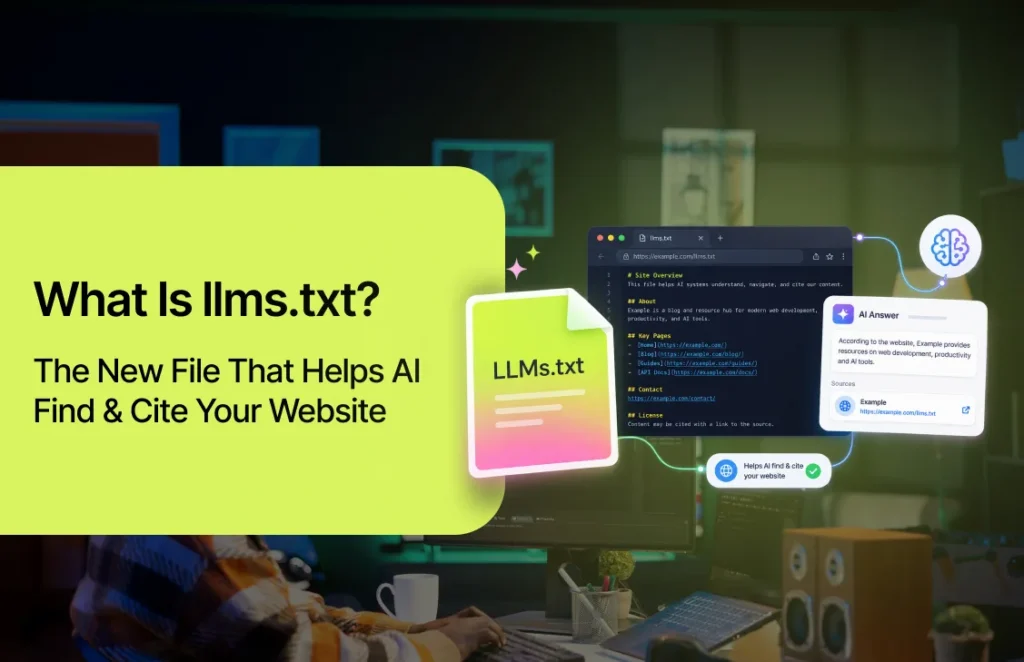
llms.txt is a plain text file, written in Markdown, that sits at the root of your website at yourdomain.com.au/llms.txt. It gives large language models a curated summary of your site: who you are, what you do, and direct links to the pages that matter most, each with a short description.
The idea was proposed in September 2024 by Jeremy Howard, an Australian AI researcher and co-founder of Answer.AI. The problem it addresses is real. When an AI tool fetches one of your web pages, it receives raw HTML stuffed with navigation menus, cookie banners, scripts, and footers, and it has to extract your actual content from that noise within a limited processing window. llms.txt hands the model a clean, distraction-free index instead.
A companion file, llms-full.txt, goes further by bundling your full page content into one large Markdown document. Most Sydney businesses only need the standard file; the full version mainly suits documentation-heavy software and technical sites.
How is llms.txt different from robots.txt and a sitemap?
These three files are cousins with very different jobs, and confusing them leads to bad decisions.
| robots.txt | sitemap.xml | llms.txt | |
| Main job | Tells crawlers what they may not access | Lists every URL you want indexed | Curates your best content for AI systems |
| Audience | Search engine and AI crawlers | Search engines | Large language models and AI agents |
| Approach | Exclusion and permission | Complete inventory | Selective highlights with context |
| Format | Directive rules | XML | Markdown, readable by humans too |
| Status | Long-established standard | Long-established standard | Proposed standard, adoption still forming |
The short version: robots.txt is the do-not-enter sign, the sitemap is the full address book, and llms.txt is the guided tour. Importantly, llms.txt does not block anything. If you want to stop AI crawlers accessing your site, that is still a robots.txt job, using user agent rules for crawlers such as GPTBot or Google-Extended. The two files work in opposite directions and should be reviewed together, since it makes no sense to hand AI a guided tour in one file while blocking the same crawlers in the other.
Does AI actually use llms.txt?
Here is the part most guides skip, and the reason to hold the hype at arm's length.
As of 2026, no major consumer AI search engine has publicly confirmed that it consumes llms.txt when answering user questions. That includes ChatGPT search, Google AI Overviews and AI Mode, Gemini, Perplexity, and Copilot. Google's own search team has been openly lukewarm, with its representatives noting that AI systems currently rely on standard crawling, and suggesting site owners consider a noindex header on the file so it does not end up in normal search results.
At the same time, the file is not shouting into the void. Server logs across the web show AI-related crawlers do fetch llms.txt files, and the strongest uptake is in the developer ecosystem, where coding assistants and AI agents use these files to read documentation efficiently. Major technology companies publish them for exactly that reason. Some businesses also report faster, more accurate brand descriptions in AI tools after publishing curated AI-facing content, though this evidence is anecdotal rather than proven at scale.
So the honest verdict is this: llms.txt is cheap insurance. It costs an hour, it cannot hurt you, your competitors' pages will not outrank you because of it, and if a major answer engine flips the switch tomorrow, you are already there. What it is not is a shortcut. Anyone promising that this file alone will get you cited by ChatGPT is overselling, and Google's spam policies aside, AI systems build their picture of your business from your actual content, your entity signals, and what the wider web says about you. The file is a supplement to that work, never a substitute.
What does an llms.txt file look like?
The specification is deliberately simple. A valid file uses one H1 heading with your business name, a blockquote with a one-or-two-sentence summary, optional context paragraphs, and H2 sections grouping your key links, each link with a short description after a colon.
Be careful here, because plenty of published examples online use invented formats with directives and version numbers that are not part of the specification at all. A model can still muddle through a malformed file, but if you are going to publish one, publish it correctly. Here is a spec-correct example for a fictional Sydney trade business:
# Harbour City Electrical
> Licensed electricians serving Parramatta and Western Sydney,
> specialising in residential rewiring, switchboard upgrades,
> and 24-hour emergency callouts. Family-owned since 2009.
We service all suburbs across Greater Western Sydney, including
Parramatta, Blacktown, Penrith, and Castle Hill.
## Services
- [Switchboard Upgrades](https://example.com.au/switchboard-upgrades/): Costs, timeframes, and compliance requirements for NSW switchboard replacements
- [Emergency Electrician](https://example.com.au/emergency-electrician/): 24-hour callout process, response times, and after-hours rates
- [EV Charger Installation](https://example.com.au/ev-charger-installation/): Home charger options, installation requirements, and typical pricing
## About
- [About Us](https://example.com.au/about/): Company history, licensing details, and team qualifications
- [Service Areas](https://example.com.au/service-areas/): Full list of Sydney suburbs we cover
## Support
- [FAQs](https://example.com.au/faqs/): Answers to common questions about pricing, safety certificates, and bookings
- [Contact](https://example.com.au/contact/): Phone, email, and quote request form
Notice what makes this work. The blockquote is the sentence you would want an AI to reuse when describing the business. Every link answers a distinct question a customer might ask. And nothing in it would embarrass you if a human read it as a start-here page, which is a good test for whether your file is genuinely curated.
How do you create and install llms.txt?
For most Sydney businesses, this is an afternoon job at most:
- Choose your pages. Pick the ten to twenty URLs that best answer customer questions: core service pages, about page, FAQs, pricing information, and your strongest guides. Leave out thin pages, tag archives, and anything you would not show a new customer first.
- Write the file. Follow the structure above in any text editor. Keep descriptions factual and specific, and make sure everything in the file matches what the pages actually say, because a mismatch between your AI-facing summary and your visible content is exactly the kind of inconsistency that erodes trust.
- Upload it to your site root. The file must be reachable at yourdomain.com.au/llms.txt. On WordPress, the major SEO plugins now generate and maintain the file automatically from your settings, which suits most WordPress and Elementor sites and removes the manual upload step entirely.
- Check that robots.txt is not blocking it. Confirm AI crawlers can actually reach the file and the pages it lists.
- Keep it current. A stale file pointing at stale pages signals a stale site. Review it whenever you add or restructure key pages, and put a quarterly reminder in the calendar regardless.
How do you know if AI is actually reading your file?
Rather than trusting general claims in either direction, check your own evidence. Your server access logs or CDN analytics will show requests to /llms.txt, and you can filter them by known AI crawler user agents such as GPTBot, ClaudeBot, PerplexityBot, and Google-Extended. If those crawlers are fetching the file monthly, it is earning its place and worth expanding. If nothing has touched it in six months, you have lost nothing and learned where not to spend further effort.
Pair that with the citation testing you should already be running: asking the major AI tools the questions your customers ask and recording whether your business is named and described accurately. The file is one input; the citations are the outcome that matters.
Where does llms.txt fit in your AI visibility strategy?
Near the bottom of the priority list, honestly, and knowing that is what stops you wasting budget. If your goal is being found and cited by AI systems, the work that moves the needle looks like this, roughly in order:
- Content that answers real questions directly, with question-led headings and first-sentence answers, on pages worth citing
- Entity consistency, meaning your name, address, services, and description match across your website, Google Business Profile, and directories, supported by strong local search foundations
- Structured data, including LocalBusiness, Service, and FAQPage schema
- Authority signals, from reviews, mentions, and links on sites AI systems already trust
- Technical health, so crawlers of every kind can access and index you reliably
- llms.txt, as the finishing touch that makes all of the above easier for a machine to read
The first five are the substance of generative engine optimisation for Sydney businesses, and they are also what determines whether you appear when customers use Google's AI Mode to find businesses. Do them first, then spend the hour on the file.
Where Digitalzoop fits in
We build AI visibility into our SEO work for Sydney businesses as one discipline, from entity and schema foundations through to citation tracking, and yes, we set up llms.txt as part of it, correctly formatted and honestly positioned as the small piece it is. You work directly with our senior team; there are no lock-in contracts, and we will tell you plainly which parts of AI search optimisation deserve your budget and which are hype. If you want a clear picture of how AI systems currently see your business, get in touch, and we will show you.
Frequently asked questions
What is an llms.txt file in simple terms?
It is a plain Markdown file at yourdomain.com.au/llms.txt that gives AI systems a curated map of your website: a one-line summary of your business plus links to your most important pages with short descriptions. Think of it as a guided tour written for machines.
Is llms.txt the same as robots.txt?
No, they do opposite jobs. robots.txt tells crawlers what they may not access, while llms.txt highlights the content you want AI systems to prioritise. You should review them together so one is not blocking what the other promotes.
Do ChatGPT and Google actually read llms.txt?
No major consumer AI search engine has confirmed using it to answer questions as of 2026. Some AI crawlers and developer tools do fetch the file, so publishing one is low-cost preparation rather than a proven ranking lever. Check your server logs for the real answer on your own site.
Will llms.txt improve my Google rankings?
No. It does not affect traditional search rankings, and Google has suggested keeping the file out of its index entirely. Its purpose is AI readability and future readiness, not SEO in the classic sense.
How do I add llms.txt to a WordPress website?
The major WordPress SEO plugins can now generate the file automatically from your settings, which is the easiest route. Otherwise, write the file in a text editor following the Markdown specification and upload it to your site's root directory so it loads at yourdomain.com.au/llms.txt.