
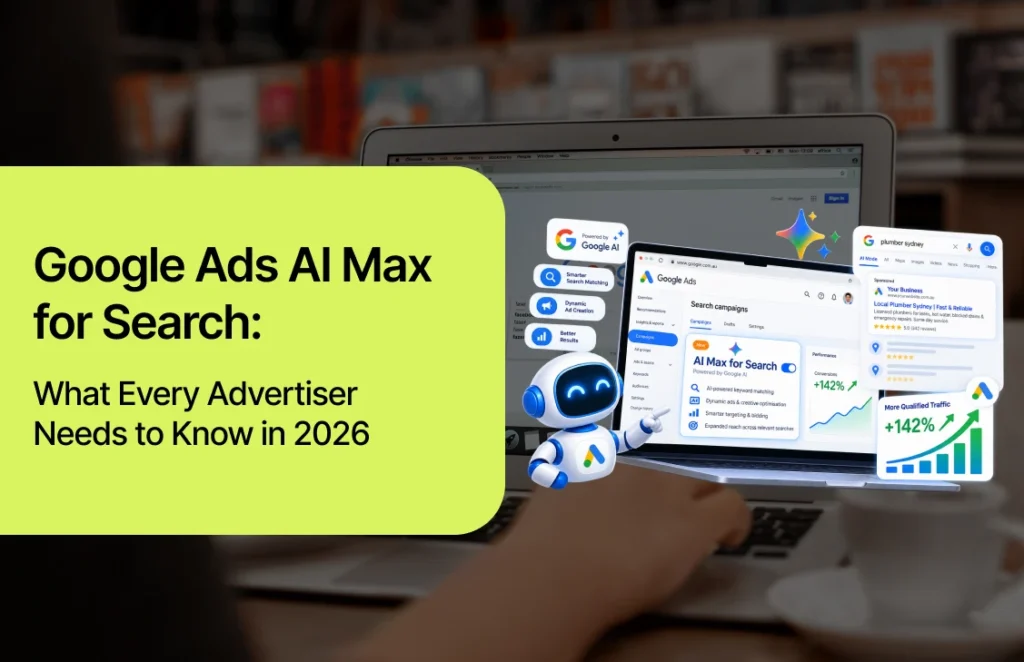
If you run Google Ads, you have seen the prompt in your account: turn on AI Max, reach more customers, one click. What the prompt does not tell you is that from September 2026, parts of this stop being optional. Campaigns using automatically created assets or the campaign-level broad match setting will be upgraded to AI Max automatically, and Dynamic Search Ads follow in February 2027.
That makes this the right moment for every Sydney advertiser to understand what Google Ads AI Max actually does, whether it helps or hurts your kind of account, and what to prepare before Google flips the switch for you. This guide gives you the honest version.
What Is Google Ads AI Max?
AI Max for Search is a suite of automation features that sits inside your existing Search campaigns. It is not a new campaign type. When you enable it, Google AI expands your targeting beyond your keyword list, generates ad copy variations to match each search, and can send clicks to whichever page on your site it judges most relevant.
Google introduced AI Max in beta in May 2025 and has expanded it steadily since, adding an AI Brief control in April 2026 along with versions for Shopping and travel campaigns. It represents Google's broader direction: moving decisions that advertisers once made manually, keyword by keyword, into an AI system that interprets the search and your business together.
The simplest accurate description is this: AI Max is broad match plus keywordless matching, extended further, with automated ad copy and landing page selection layered on top. Understanding it as a reach expansion tool, rather than a new strategy, is the key to using it well.
What Are the Three Features Inside AI Max for Search?
AI Max bundles three components, and you can control them individually:
- Search term matching. The engine of the suite. Google matches your ads to queries beyond your keyword list using broad match technology and keywordless matching drawn from your landing pages. This is where the extra reach, and the extra risk, comes from.
- Text customisation. Google generates and adjusts headlines and descriptions to suit each individual search, working from your existing assets, your website, and the AI Brief you provide.
- Final URL expansion. Rather than always sending clicks to the landing page you chose, Google can route each click to the page on your site it considers the best match for the query. You can exclude pages or switch this off entirely.
The AI Brief, added in 2026, is worth singling out. It lets you steer the system in plain language: which customers to prioritise, which topics to avoid, what never to say about pricing. For Sydney businesses in careful-language industries such as finance, health, and legal services, it restores a layer of control the original release lacked.
AI Max vs Performance Max: What Is the Difference?
Advertisers often confuse the two because the names are similar. They solve different problems.
| Standard Search | AI Max for Search | Performance Max | |
| What it is | Keyword-targeted Search campaign | Automation layer inside a Search campaign | Separate campaign type across all Google channels |
| Where ads show | Google Search results | Google Search results | Search, Shopping, YouTube, Display, Gmail, Maps |
| Targeting | Your keywords and match types | Your keywords plus AI-expanded queries | Audience signals and asset groups, no keywords |
| Control level | Highest | Medium, with per-feature toggles | Lowest |
| Reporting visibility | Full search term data | Search term data retained | Limited placement and query detail |
| Best suited to | Tight budgets, precise intent | Search accounts with untapped query volume | Established accounts wanting full-funnel reach |
The practical takeaway: Performance Max campaigns replace your campaign structure and spread spend across every Google surface, while AI Max keeps you inside Search with your keywords and reporting intact, then widens the net. For most Sydney service businesses, that makes AI Max the less drastic of the two automation paths, and the one where mistakes are easier to see and correct.
What Changes in September 2026, and What Moved to 2027?
This is the part many advertisers have wrong, because Google changed the schedule mid-year.
Google originally announced that Dynamic Search Ads, automatically created assets, and campaign-level broad match would all auto-upgrade into AI Max from September 2026. In June 2026, Google postponed the Dynamic Search Ads migration to February 2027 after advertiser feedback, keeping it clear of the busy final quarter, and restored the ability to create new DSA campaigns in the meantime.
The September 2026 deadline still stands for the other two. So the timeline now runs in two waves:
- September 2026: campaigns using automatically created assets or the campaign-level broad match setting begin upgrading to AI Max automatically.
- February 2027: remaining Dynamic Search Ads campaigns migrate to AI Max, with existing URL controls preserved.
The trap here is the quiet upgrade. Plenty of Sydney accounts are running campaign-level broad match or automatically created assets because an agency or a Google recommendation enabled it years ago, and nobody remembers. Those accounts will wake up in spring running AI Max without anyone having made a decision. Check your settings now, while the choice of timing and configuration is still yours.
Does AI Max Actually Improve Results?
Google's published figures claim up to 14 per cent more conversions at a similar cost per acquisition for advertisers outside retail, rising to around 27 per cent for campaigns that relied mainly on exact and phrase match. Google has also promoted strong individual case studies, including an Australian utilities connection business reporting more leads at a lower cost per acquisition.
Treat those numbers with the context they deserve. They are Google's own figures, the headline number excludes retail, and the biggest gains go to accounts that previously restricted themselves to exact and phrase match, precisely because AI Max opens query volume they were never bidding on. Independent reporting and agency experience across the industry has been more mixed, with modest revenue gains often arriving alongside higher costs per acquisition and a noticeable share of looser, lower-intent queries that need constant negative keyword work.
From our own Google Ads management experience across Sydney accounts, the pattern is consistent with that: the expansion genuinely finds new converting queries in some accounts, and quietly buys junk clicks in others. Which outcome you get depends almost entirely on the state of your account before you switch it on, which is what the next section covers. And because those extra clicks are billed like any others, it pays to understand what Google Ads costs in Australia before widening your reach.
Who Should Turn On AI Max, and Who Should Wait?
AI Max tends to reward accounts with these characteristics:
- Exact and phrase match heavy campaigns with genuine untapped query volume, since that is where new high-intent searches exist to be found
- Reliable conversion volume, enough for the system to learn from, ideally with lead quality data flowing back through offline conversion imports
- Smart Bidding already in place, because expanded matching without target CPA or target ROAS bidding bleeds spend quickly
- Someone actually reviewing the search terms report, weekly at minimum, because that is where AI Max is won or lost
It tends to punish accounts where:
- Conversion tracking is patchy. If Google cannot see which enquiries became customers, it optimises for cheap form fills regardless of quality, so your cost per lead improves on paper while your cost per genuine lead worsens
- The account is already saturated with broad match and Performance Max, leaving little new ground to find
- Budgets are small. Expanded matching needs room to learn, and a tightly budgeted campaign can burn its month's spend on exploratory clicks
- Nobody is watching. AI Max is not a set-and-forget product, whatever the enable prompt implies
For smaller Sydney businesses that do not meet the ideal profile, the sensible position is not panic and not blind adoption. Keep your core campaigns on the structure that works, prepare the account properly, and if you test AI Max, do it on one campaign with your cleanest tracking. Waiting deliberately, with your settings checked so the September wave cannot switch anything on for you, is a perfectly valid strategy.
How Do You Prepare Your Account Before the Auto-Upgrade?
Whether you plan to embrace AI Max or delay it, this preparation protects you either way:
- Audit what will migrate. Check every campaign for automatically created assets and campaign-level broad match now, and list your Dynamic Search Ads campaigns for the February 2027 wave.
- Fix conversion tracking first. Enhanced conversions, correctly mapped primary conversion actions, and offline conversion import for lead generation. This is the single most important prerequisite, because every AI Max decision runs on this data.
- Move off manual bidding. Any migrating campaign still on manual or enhanced CPC needs a Smart Bidding strategy with a realistic target before the upgrade, not after.
- Pre-stage your negative keywords. Pull the last 90 days of search terms, add the irrelevant ones to shared negative lists, and expect query volume to grow substantially once matching expands. Your negatives are the brakes; fit them before the hill.
- Set your URL exclusions. Block final URL expansion from routing paid clicks to careers pages, thank-you pages, blog archives, or anywhere that cannot convert.
- Apply brand exclusions. Stop expanded matching from spending your budget on your own brand name or appearing against brands you have no business matching.
- Draft an AI Brief. Give Google structured guidance on your audience, your no-go topics, and any compliance language before the system starts writing copy on your behalf.
- Record a baseline. Capture four weeks of pre-migration performance so you can judge the change on evidence rather than impressions.
How Do You Run AI Max Without Losing Control?
If you do enable it, a few guardrails separate the accounts that benefit from the ones that quietly overspend. Run it as a proper experiment against your existing setup rather than switching everything at once, so you get a clean comparison. Enable one feature at a time, starting with search term matching, so you can see what is actually driving any change. Review search terms weekly and keep adding negatives, because the expansion never stops probing. Lock the copy that matters, including legal phrasing and offers, so text customisation cannot rewrite it. And judge the result on a business measure such as cost per qualified lead or revenue, not blended cost per conversion, because extra conversions are only a win when they are worth having. If AI Max sends visitors to unexpected pages, make sure your remarketing setup is capturing them so the wider net still feeds your pipeline.
What Does This Mean for Sydney Businesses?
Google Ads automation is no longer something you opt into piece by piece; it is the direction the whole platform is moving, with AI Max in Search, Performance Max across channels, and AI-generated ads appearing inside AI-driven results. For Sydney advertisers, particularly service businesses across Parramatta and Western Sydney competing on high-intent local searches, the winners will be the accounts with clean tracking, disciplined negatives, and someone paying attention, because those are the accounts where the automation has good data to work with and firm boundaries to work inside.
It also sharpens the case for balancing channels sensibly. Paid search costs rise when matching loosens, which is one more reason the SEO versus Google Ads decision deserves a proper look rather than defaulting to more ad spend.
Where Digitalzoop Fits In
Our Google Ads management team in Sydney is working through exactly this transition with clients: auditing which campaigns the September wave will touch, fixing tracking before the automation depends on it, and running controlled AI Max tests where the account profile justifies one. You work directly with our senior team, there are no lock-in contracts, and we judge campaigns on enquiries and revenue rather than click volume. If you want to know whether your account is ready for the upgrade, or whether it is about to be upgraded without you, contact us for a straight answer before September arrives.
Frequently Asked Questions
What is AI Max for Search in Google Ads?
AI Max for Search is a set of automation features you enable inside an existing Search campaign. It expands your targeting beyond your keyword list, generates ad copy variations for each search, and can choose the landing page for each click.
Is AI Max the same as Performance Max?
No. Performance Max is a separate campaign type that runs across Search, Shopping, YouTube, Display, and more with limited visibility. AI Max stays inside your Search campaigns, keeps your keywords and search term reporting, and gives you per-feature controls.
Will my campaigns be switched to AI Max automatically?
Campaigns using automatically created assets or campaign-level broad match begin auto-upgrading from September 2026. Dynamic Search Ads migrate from February 2027 after Google postponed that wave. Standard keyword campaigns without those settings are not force-upgraded.
Does AI Max reduce cost per conversion?
Google reports up to 14 per cent more conversions at a similar cost for non-retail advertisers, with larger gains for exact and phrase match accounts. Independent results are more mixed, so test it as a controlled experiment and judge it on lead quality, not just volume.
Can I turn off parts of AI Max?
Yes. Search term matching, text customisation, and final URL expansion can each be switched on or off separately, and you can add brand exclusions and URL exclusions. That per-feature control is one of its main advantages over Performance Max.